For those who may have missed it, Chris Despos left an interesting comment on the Caraceni post that I am going to reprint. Those outside the U.S. may not know that Despos is considered one of the top bespoke tailors over here, so his input is greatly appreciated. Even more appreciated is his direct insight on the subject which is why I am reposting his comment here.
Jeffery,
Interesting post. I worked 3 years with a tailor from this shop. We would blunt the corners on sleeves and vents even for the basted try on. The process after the try on was to make the lower pockets then turn the front edges, sew them down then baste on the facings. After the lapels were done we would position and make the breast pocket, cutting thru the canvass, haircloth and flannel. This is a nice method and accommodates a pocket square quite well. Because the pocket is put thru the canvass to the inside, the bulk of the square is between the canvass and the lining rather than between the canvass and the cloth. We would cut the haircloth for the chest in two pieces. from midpoint of the chest up it was cut in the normal way. We would cut the bottom piece on the bias and attach it to the other piece. This gave a firm shoulder and a soft chest. This was the last 3 years of 9 years apprenticing. Great experience and opportunity to make clothes in this way. Most of these techniques have been abandoned.
Cutting the breast welt through the canvas is pretty old-school. Frank Shattuck was telling me last week that he still does it this way as well. Caraceni's method seems to have changed slightly in the meantime, from what Chris described.
Here is a view of the inside of the breast welt, which is more often now made before applying the canvas and as such is sandwiched between the cloth and the canvas. Chris is right to point out that it makes a cleaner chest to cut it through the canvas. I'm not a fan of cutting through the haircloth, but we will see that in this coat, that was not done. Nor was it sewn through the felt, which, in this case, has been applied by hand and trimmed around the pocket.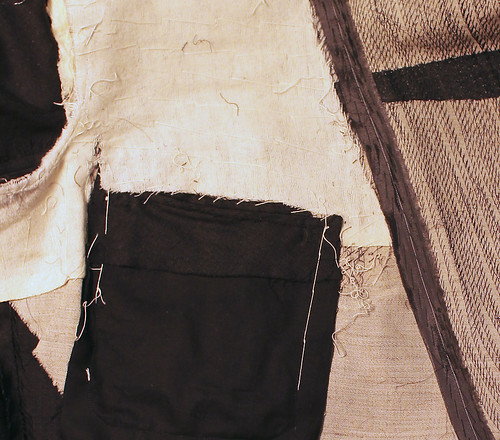
With the felt gone, we can see that the chest piece was split just below the breast line, and another piece of wool canvas butted to it. The breast welt was sewn through two layers of wool canvas, rather than canvas and haircloth. We can see that an additional piece of wool canvas, on the bias, was added to the shoulder for additional support, and the whole is heavily padded by blindstitch machine.
Oh and Chris' thoughts on the mezzaluna tacks:
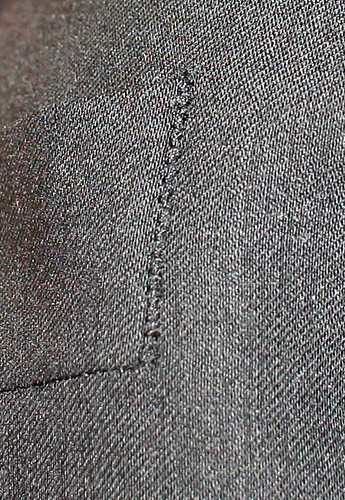
Mezzaluna tacks hold the interior pipes in place and help support the stress on the pocket pipes. It binds the pipes to the cloth. Much stronger than a hand bar tack that is more decorative than functional. Actually I do bar tacks with a buttonhole stitch on trouser pockets.
Despos
Thanks, Chris.




 Posts
Posts



