Showing posts sorted by date for query super. Sort by relevance Show all posts

Friday, January 10, 2020

"Robert Jeffery"


Wow.  It's been 12 years since I started this blog. The focus has shifted over time, and I seem to have been writing less and less, mostly since life happened and I got busy (and married) and moved all over the place.  I feel the time is right to devote more time to blogging again, especially since I now have help.

The first major thing to talk about is the migration from Blogspot/Blogger and Flickr, etc. to my own site.  Sites like Blogspot are great because they are free and easy, but you don't really own your content (you get what you pay for).  Sadly, a lot of my photos in older posts are now lost because some photo hosting sites decided to change the terms and conditions.  I considered moving over to Instagram but that's just another place where you are at the mercy of someone in San Francisco.  The other thing is I have a lot of new projects on the go and I think it's time I consolidated everything into one spot.  So my new website, which is still being developed, can be found at robertjeffery.us. "Robert Jeffery" is also the name of the company I formed last year. 



The Tuttofattoamano/Made by Hand blog will be hosted under this umbrella, as well as a few related sites like my ladies wear (The Louise Collection), and an activewear collection to be launched later this year.  So I apologize for any inconvenience if you have come looking for old articles on Blogspot which you can`t find anymore but hopefully the new blog site at robertjeffery.us will be far more searchable so you can find old stuff more easily.

So what have I been up to lately?  I'm still happily busy at Hickey Freeman in Rochester, New York, but have been traveling back and forth to Montreal every week, spending time at our Samuelsohn facility, where we have made suits for almost 100 years, and recently also began sewing shirts, as well as a Canadian brand of outerwear called Moose Knuckles.

For almost a year now I have also been working on some new technology to draft patterns from body measurements with the intent to modernize made-to-measure (MTM).  I know there are tons of websites out there that claim to already make custom patterns from photos and body scans but I have yet to see technology that I would actually want to use and hang my reputation as a tailor on.  So I teamed up with some clever people in Europe who had already begun working on something and we will begin live beta testing in the very near future.  More on that soon.

Last summer I accidentally started a line of ladies tailored clothing.  By "accidentally", I mean I wanted to put together a little group of ladies' suits as a tribute to our late congresswoman, to be shown at a charity fundraiser in Rochester.  It didn't occur to me at the time people might actually be interested in buying the stuff, so we had to quickly cobble together a company and a website to make the line available publicly.  The Louise Collection belongs to Robert Jeffery, LLC, and is being produced at the factory that makes Hickey Freeman in Rochester.  Right now it is only made to measure, by appointment, but we are considering bringing it to a wider market through carefully selected retailers in the United States and maybe eventually Europe.


I couldn't have done any of that without the help of my husband, who is the director of operations for Robert Jeffery.  He is handling the website(s), the book keeping, billing, scheduling, daily operations, and is also my in-house Salesforce system admin.  A former competitive bodybuilder, he's always had trouble finding clothes, and I have always had trouble getting him into suits, which is a bit of a shame considering... Like the aforementioned technology, there are products on the market which purport to be made to fit athletic guys, but again, I found most of them lacking.  And the good ones in Europe and Australia are either super expensive to have shipped to the US, if they will even ship at all, and don't extend into the larger sizes needed by big American boys.  So he decided we should launch a line of activewear and athleisure for that specific market.  To the extent that the market will permit it, we want to have most or all of it made in the United States.  Again, more on that in due course.


So with all that said, I'll stop posting here on Blogspot - go check out our new home on the web at https://robertjeffery.us/tuttofattoamano/

[Please go to the new Tuttofattoamano to comment]

StumbleUpon.com

Friday, May 1, 2015

Classic Tailoring Techniques for Menswear

The long-awaited revision of what is perhaps the definitive English-language textbook on traditional tailoring techniques (at least of those currently being published) has been released.


Classic Tailoring Techniques for Menswear is a textbook published by Bloomsbury Publishing, and has been revised by Denis Antoine, a teacher of menswear at the Savannah College of Art and Design. While other publications may be more thorough treatments of the subject, books like those written by the late Stanley Hostek are not as clearly presented for the novice, and the coveted Modern Tailor, Outfitter and Clothier have been out of print since the 1950's so complete, three-volume sets are comparatively rare and expensive. Then there is R. Doyle's The Art of the Tailor, which seems not much more than a copy-and-paste job by an enthusiastic but misguided amateur who may be waltzing very near the edges, if not trampling directly upon the Berne Convention. The bibliography lists a number of other titles which may be useful to the student, as well as a few supply sources.

I have often said that learning tailoring from a book is somewhat akin to learning to play piano from a book, but for those who have no access to a teacher this is as good a place to start as any, and it is certainly a very good accompaniment to any formal course of study.

Chapters include the following:

1- Tailoring (history, supplies and basic techniques)
2- The pattern (measurements, patterns, preliminary adjustments)
3- The fit (toile or muslin fittings and pattern adjustments or "blue pencil")
4- Fabric (weights, patterns, etc.)
5- Layout and Cutting (matching stripes and plaids etc.)
6- The Jacket-
Darts and Seams
Ironwork
Pockets
The canvas
The facing
The lining
Shoulders
The collar
The sleeve
Buttons and buttonholes
7- The Pants
Ironwork
The crotch
Pockets
Fly
Side seams
Waistband
Hem
8- The Vest
9- Alterations

700 new photos and illustrations are included in this revision and one of the most helpful aspects is the addition of color to the diagrams which help enormously with the clarity of the instructions. Some of the photos are somewhat dark and slightly fuzzy, but I am well aware of the difficulty of photographing this type of thing and am not sure how it could be done better. On the whole, though, the graphic representations of the steps involved are one of the great strengths of this book and are of enormous value to the student or beginner


New to this edition is a discussion of ironwork. The photos illustrating the technique are not super clear, but I happen to think that this is something best learned at the hands of a teacher and at least the book broaches the subject so that students are aware of the principle and the need for it so it is an improvement on the previous edition.

The methods presented are probably one of the better systems for the beginner, avoiding many of the personal quirks and regional variations that tend to plague other forms of instruction, whether in print or in newer video format. There are as many ways of constructing a coat as there are tailors, but I feel the book presents methods that would be easily adapted to most workshops rather than idiosyncrasies that lend personal flavor to a garment but are best left to experimentation and discovery once the student has a firm grasp of the basics.

I am somewhat perplexed, however, by the treatment of collars. The text discusses the use of the collar pattern that may have been provided with whatever commercial jacket pattern was being used, and has good instructions for drafting a collar pattern, save for one error in the final steps of the draft. Though useful for advanced tailors and certainly for people working in the RTW industry, I think that the more traditional method of shaping the under collar would be more in keeping with the overall subject of the book. Rather than using a pre-shaped pattern for a collar, a blocked under collar is typically attached to the coat with a fair amount of extra width on it once the facing has been attached. The collar is then shaped either freehand, or better yet, using a paper shaper, and the excess is trimmed away; using a pre-shaped under collar requires a very great deal of precision when attaching it in order to have a perfectly even and symmetrical shape from one side to the other. Helpful patterns for parts like pocket and fly pieces are included at the back of the book, and I feel that shapers would have been a very good addition to these, especially since they were often included in earlier books aimed at the professional, whether for use in traditional tailoring methods or for drafting paper patterns for wholesale. A sample of these shapers can be found near the back of the Modern Mitchell System of Men's Designing-


Space, time, or other restrictions may have dictated this, as well as the one-page treatment of final pressing, something which I feel deserves and entire chapter, if not an entire book. Again, the author may have felt that these were things best learnt in their entirety at the hands of an experienced practitioner rather than trying to explain them poorly in print.

The book is not exactly cheap, though textbooks never are, so if you own a previous edition of it I don't think I would upgrade to this latest one. It's a book, after all, not an iPhone. But if you don't have a copy and are learning, or trying to learn, the complex craft of tailoring, I consider this new edition of the text to be a must-have in your library.

StumbleUpon.com

Wednesday, January 18, 2012

O'Mast

My copy came in the mail this week.

O'MAST from Kid Dandy on Vimeo.


One of the few pleasures that I have derived from working in tailored clothing factories, as opposed to working in a tailor shop, is that there are invariably a sizable group of old guys from the old world who like nothing better than to sit around, shooting the breeze and talking about what life was like back in the day. Back in the day meaning, of course, back in Italy. I could almost write a book. In fact, maybe someday I will.

O'Mast, a documentary by Gianluca Migliarotti, is an intimate portrait of some of the last remaining Neapolitan tailors and their clients. Perhaps lacking in a definite story or arc, it was exactly like sitting around on a coffee or lunch break with the guys. Only missing was coffee. While the stories had an immediate appeal for me because they were so familiar, one thing jumped out at me for the first time, if only because of the context of some of the recent political discourse.

(If you're interested, and if you are a regular reader of this blog I should think you will be interested, the DVD is only about $25 and cad be had at the Armoury's website. The Armoury is in Hong Kong but shipping was super fast.)

It's a story I have heard a thousand times if I have heard it once. At age 11 or 12, a young boy would be sent to the tailor shop to apprentice. Maybe after school. Maybe afternoons. Maybe he would drop out of school entirely. His pay, if he were lucky enough to get any, might be 100 to 150 lire a week. He would ride his bike from his village several miles to the nearest bus or train, where he would spend his weekly salary on train fare into the city. The lucky ones might have enough left at the end of the week to buy a cup of coffee, though not likely. At Christmas the master expected a gift or tribute of some sort to thank him for the time he spent training the young apprentice. The system produced some of the best tailors in the world, and helped drive the eventual cachet of the "Made in Italy" brand.

Perhaps I have become desensitized to the story, having heard it so many times. More likely I can relate in a sense since, like so many other pursuits, it is generally agreed that one must start early in life in order to gain a proper mastery; piano lessons, ballet lessons, gymnastics... those who become successful at these pursuits are more likely to have started lessons at age six than at age 20. Something to do with the 10,000 hour rule.

Those readers who are fortunate enough to be insulated from the Republican primary season here in the U.S. will have missed Newt Gingrich's recent assertion that poor children should be made to work as janitors in school. My initial reaction was, naturally, one of shock and indignation. He did, suggest, however, that they be paid some sort of wage, which is more than can be said for the tailor's apprentice. So what was a charming story about learning the craft of tailoring now has the taint of child labor. How do I reconcile the two?

I'm not sure that I can.

It's one thing to say that it was an economic necessity and a part of the harsh reality of post-war Europe that children had to be sent out at a young age to work, essentially, for free, with the only benefit being that they were learning a marketable skill. But the same logic could be applied to Newt's argument and I'm not sure that's a good thing. It also highlights the question of whether such a training regimen was really necessary in order to create the generation of craftsmen that is currently disappearing and is not likely to be replaced without such a draconian system of apprenticeship.

While I am certain that each of the tailors interviewed in the film would tell you that they were entirely thrilled to have had the chance to apprentice as they did, I am equally convinced that not one of them would send his own child out to repeat the process.

I don't really have a point here. I'm just thinking out loud. In print. Whatever.

StumbleUpon.com

Friday, August 19, 2011

Men's Factory-Made Clothing

A few book reviews to do.

Basted

The first will appeal only to the super-geeks like myself. Published in 1916, The Men's Factory-Made Clothing Industry is a report on the cost of producing men's clothing produced by the U.S. Department of Commerce, and can be found on Google Books.


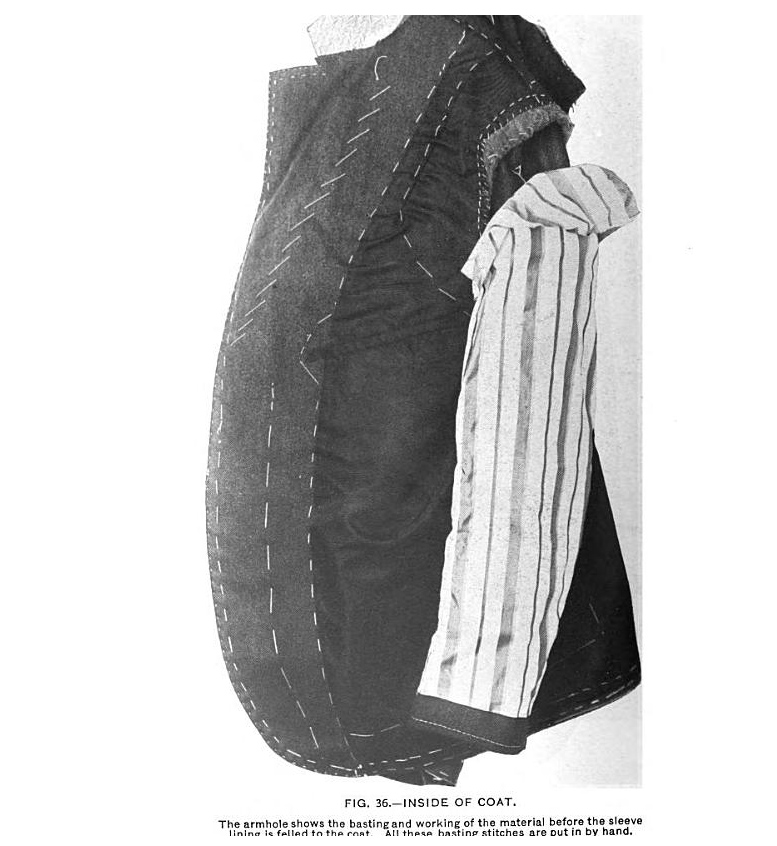
Buried within a lot of dry financial statistics is an interesting history of ready-to-wear clothing in the U.S., as well as some very interesting descriptions of the manufacturing process, some of the machines already in use at that time, and some startling passages such as the following:

"The imports of clothing into the United States are almost negligible and are generally English overcoats, novelty garments like the Balmacaan, and golfing and motoring clothes. No sack suits are imported.

...

English ready-made clothing is not comparable with the American. The English hand tailoring is poor, except in the finest custom work. Very conservative styles of men's clothing are worn in England; the models do not change from one season to another as they do in this country. High-salaried designers [ahem] are employed by the larger clothing factories in the United States, who are constantly introducing attractive styles.

...

American people believe not only that the styles of clothing for men that are originated in the United States are superior to those that come from other countries, but also that the workmanship of the domestic product is superior to the workmanship on ready-made clothing produced in foreign countries. This belief accounts, in a measure, for the tremendous increase in the production of factory-made clothing in the United States during the last 20 years.

While the manufacture of ready-made clothing is one of the large industries in the United States, this industry is of comparatively small importance in other countries. The completeness of the factory equipment, the thoroughness of the factory organization, and the efficiency of the working force, which are noticeable in many establishments for making men's clothing in this country, are not even approached in other countries. Nearly all the ready-made clothing manufactured in Europe is of low-grade, cheap varieties, and is almost invariably manufactured in small factories, in shops, or in the homes of the workers."

Insides

I knew that the method of manufacturing by breaking down the process into minute operations had originated in the U.S. and had been exported to Europe, but was a bit startled by the assertions about the level of quality, mainly because the reverse is often true today. In retrospect, however, it makes perfect sense. But taking it into a larger context, we can trace the progression of the source of quality goods from the U.S., then to Italy who has held the crown since Brioni started to push the "Made in Italy" brand back in the fifties, and now it's moving to China. Many people still associate Chinese-made product with inferior quality, just as Japanese electronics were once considered junk, but those of us who have actually visited facilities in China know that they are not far off from the potential of eclipsing Italy in terms of production of quality garments.

I hope I'm still around in 50 years so I can witness for myself how the manufacturing landscape will have evolved.

StumbleUpon.com

Saturday, February 12, 2011

Despos

Despos04

In the world of tailored clothing, there are houses that are, in my opinion, seriously overhyped, and others who deserve a lot more attention than they get. Chris Despos falls into the latter category.

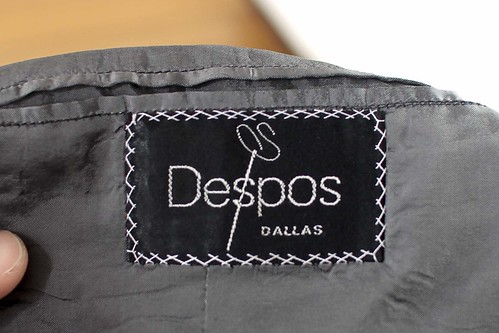
Based now in Chicago, Chris once operated out of Dallas, a city he frequently travels to, in addition to others, so if you are looking for one of the country's (perhaps one of the world's) top tailors outside of the Manhattan area, you can find him in his Oak Street studio.

Many thanks to Chris for donating this suit to science.


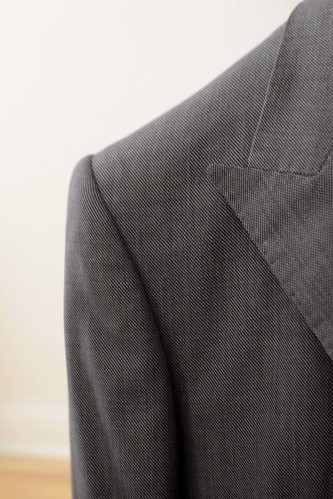
One of the first things that sets my bells ringing is this shoulder.
Despos06

Though currently out of favor but perhaps enjoying a return of sorts, one of the reason that this type of pagoda-shaped shoulder is not so commonly seen is that it represents the pinnacle in terms of difficulty of execution. In other words, it may look odd to many people because they are not used to seeing it because so few can do it right. This kind of shoulder goes beyond just aesthetics- it is actually made to conform more naturally to the actual shape and forward pitch of the human shoulder, and there is a great 3-dimensionality to it. In movie terms, this shoulder is the Avatar to so many Creatures From The Blue Lagoon. You'll be able to see what I mean a bit later in the post.

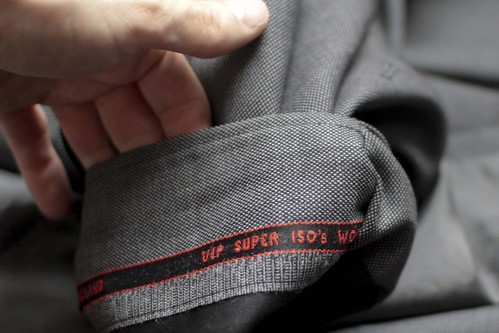
This suit was made back in 1992 but as we saw in a previous post, has held up really well despite its being made in a super 150s cloth. Chris will be annoyed with me when he sees that the coat has been sitting in a heap since my last post and is thus in need of a pressing, but another annoyed reader commented that they wanted to see more of the garments than just the guts.

Despos01

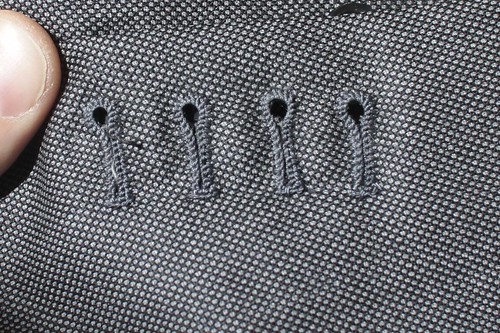
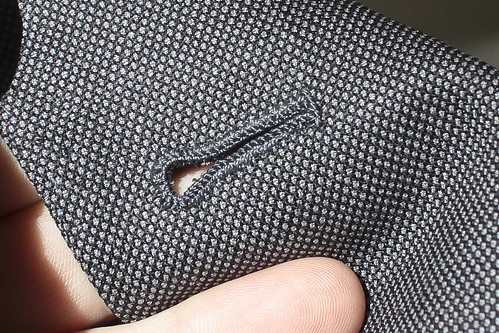
Some buttonhole porn, for those who are into that. These buttonholes are gimped with a single strand of buttonhole twist, instead of the type of gimp I use, so readers who are experimenting with buttonholes and don't have access to the Agreman gimp, here is proof that you can get perfectly good results without it.

Despos02

Despos03

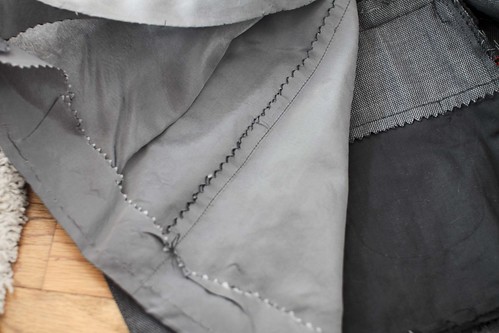
Here's something we don't see all that often anymore; the outlets and cut edges have all been pinked (cut in a zig-zag edge). This prevent the edges from fraying, especially the lining which can get really messy, and may also help to prevent seam impressions.

Despos05


The sleeve head wadding is of the Kotex type, but this has not disintegrated at all. In addition, a single, bias-cut piece of canvas reinforces the front of the sleeve.

Despos07

The back of the scye has been stayed with a piece of lining which has been backstitched by hand.
Despos08

An extra strip of self cloth has been inserted at the cap of the sleeve for smoother pressing.

Despos09

Though it doesn't show in photography, it is worth noting that the sleeves (which are very large, thank you) have been sewn into the (very small) armhole BY MACHINE. The shoulder seam has likewise been sewn BY MACHINE. I don't think that these two steps need to be done by hand, and here is an indication that neither does Despos (nor does Henry Poole, for that matter). His opinion on the matter may since have changed and if it has, I am sure he will share it with us.

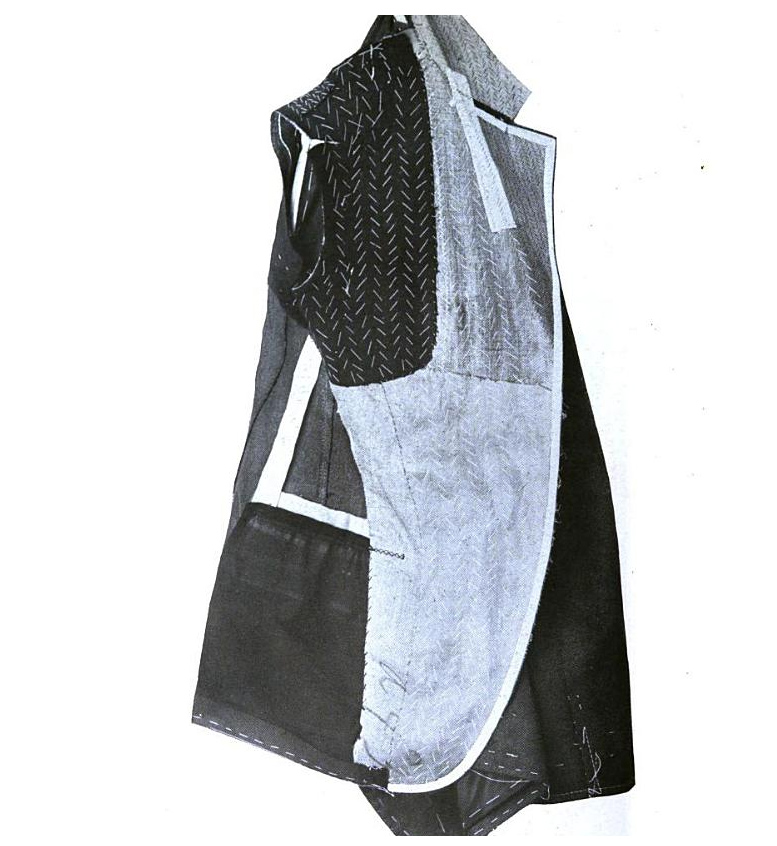
A full view of the coat front shows that his chest piece is of a moderate size, and has been worked up by hand.

Despos10

A closer look shows some of the cuts required to shape the shoulder.

Despos11

And now for a better look at what I mean about this shoulder shaping.

The pocket that has been created for the shoulder bone is very obvious here. This room is very important to the comfort of the garment- garments whose weight sits on the shoulder point are uncomfortable and don't move as well with the wearer. For this reason, shoulder seams which angle backward (and thus make it more difficult to get this forward pitch of the shoulder) are counter-productive, in my opinion.

Despos12

Even after 20 years, this shoulder has maintained its shape.

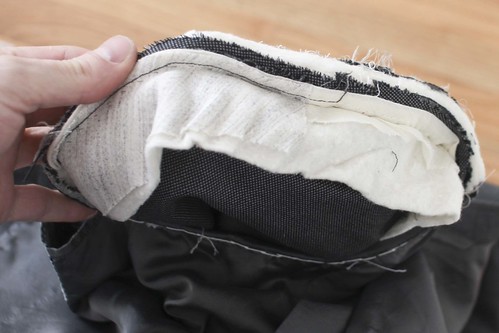
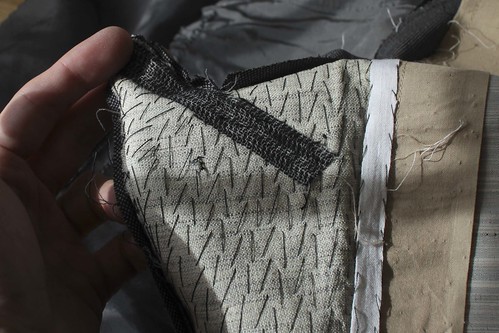
Inside the chest we see the various cuts in the haircloth which build shape, and a strip of beige silesia covering the roll portion to prevent the hair sticking through.

Despos13

A bias-cut shoulder piece is found, as expected, but somewhat unexpected is the hairline; I am more accustomed to seeing it running up toward the outside of the shoulder, but whatever works...

Despos14

A piece of weft-insertion fusible is used to stabilize the bias grain of the peak lapel.
Despos15


The lapel itself feels a little meatier than I expected so I rip some of the padstitching to have a look underneath. Sure enough, more weft-insertion under the lapel to give more volume to the roll.

Despos16

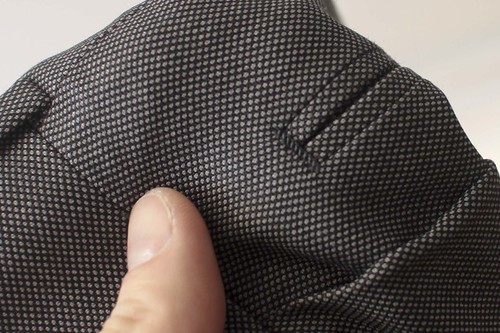
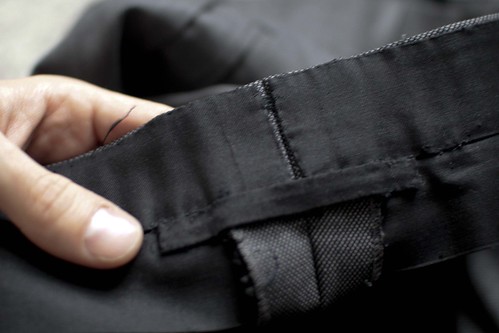
I won't dwell too long on the pants, other than to say their execution is some of the neatest I've seen from the many examples of bespoke work. A few details of note, though, are the buttonhole-stitch bartacks at the end of the pockets,

Despos17

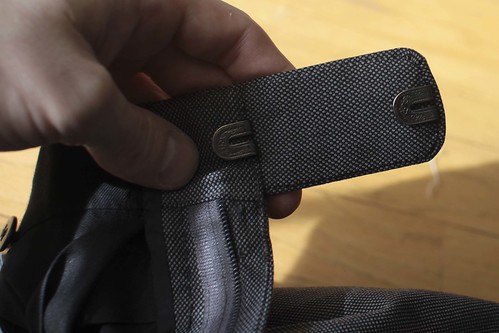
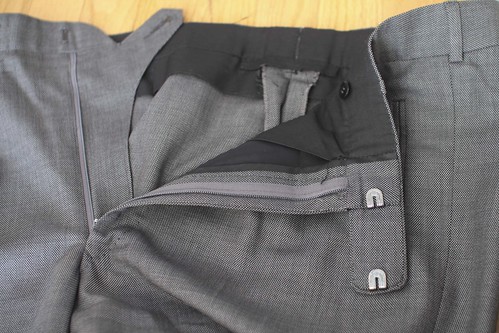
Waistband extensions are more commonly square, as they are much easier to finish than the rounded type, as this one which requires much more work and precision.

Despos18

Despos19


My general impression is that this garment is neater than the majority of examples I have seen from Saville Row houses, and in many instances, more care has been given in its execution. More work went into this garment than the Caraceni that we saw, and the house is legendary. So while the name may not carry the same appeal or cachet than some of the other, more famous houses, the level of workmanship takes a backseat to none of them.

EDIT- disambiguation. There are a number of different results when googling Despos, so to be clear, this is Chris Despos, who is located at 34 East Oak Street, Chicago, Illinois- contact me for the phone number or email address if you need it.

StumbleUpon.com

Sunday, February 6, 2011

Sartorial Mythbusting

MythBusted

The next suit to be dissected is an old bespoke number; made back in 1992, it has clearly been worn. Hard.

There is evidence of the waist having been let out

Waist

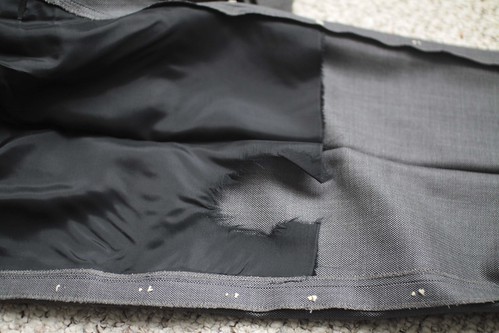
but more telling is this- the owner wore right through the knee lining.

Knees

If I look at the areas of the garment which show the most stress, namely the hem of the trouser (including the inside), the sleeve hem and the seat area, this will give me an idea of how well this particular cloth performed.

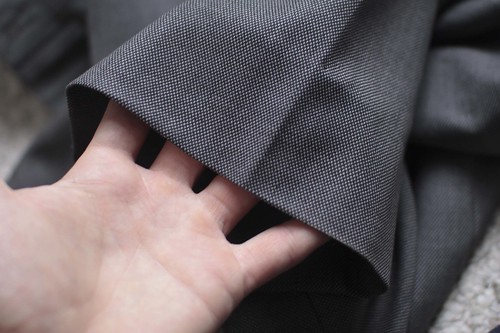
THe hem of the trouser is in almost perfect condition

Hem2

even on the inside

Hem inside

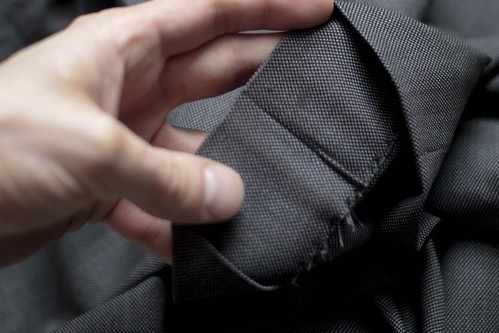
The sleeve hem shows almost no signs of wear

Cuff

and neither does the seat of the trouser.

Seat

It is quite safe to assume that this is a sturdy, English cloth. But what is surprising about this particular cloth is how fine it is.

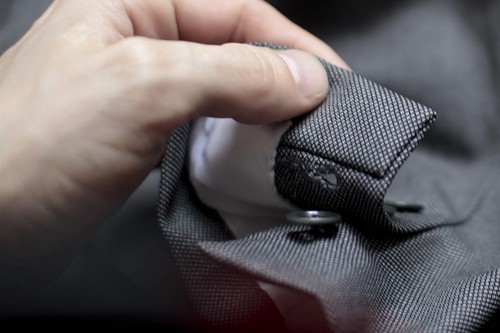
Supers


That's right, Super 150s.

One of the common myths among the iGentry is that cloths of high super-numbers (which is an indication of how fine the fibers that were used to weave the cloth are, measured in microns) are too fragile and won't hold up to wear. While some cloths (notably Italian cloth) are made up with the intent of being very fine, soft and lightweight, and thus are more fragile, it is not necessarily true that all cloths bearing high super-numbers will be fragile. This garment being a fine example (in every respect).

So when evaluating the merits of a particular cloth, please do not fall into the ill-informed trap of dismissing a cloth merely because it is made up from super-fine yarns and must, therefore, be too fragile; let your tailor, who knows how various types of cloth handle and perform, guide you instead.

StumbleUpon.com

Tuesday, November 16, 2010

A different kind of Sport Coat

Usually the dissections performed for this blog are of a destructive but educational nature. This time, I am called to tear something apart only to make something new again.

This project has been in the pipes for quite some time now, but my imminent departure has mean that it must be completed in the next few days. But let's back up a bit.

I got a call from a retailer who was looking for a favor; he had a call from an agent whose client had an idea- he had seen someone on tv flashing the inside of his blazer which was lined in jersey and the logo of his team, and client wanted one of those to commemorate a recent game. I was having a bit of trouble following so I asked them to just send me the jersey so I could have a look at it and have a better idea of what I could do with it.

A week went by and I had no news of the jersey so I called the retailer back. "Yeah, yeah", he said, "it had to go to the dry cleaners first". Heh. Well, the thing finally came. There wasn't enough of the jersey material itself to line an entire coat so I did a few sketches of what I thought could be done, which were sent off to the agent. Not approved. We went back and forth a few times until I hit on exactly what he wanted, but there was not enough jersey to do it. So time to get creative.

I figured these things had to be available on the internet, so I went surfing. Bingo. Found them. Authentic jerseys. I'll just buy a couple of these and I'll have enough, as long as they are a perfect match. But wait. Screen printed logos. Um, no, these are embroidered patches. Made in Thailand. No, this is made in, uh, Berlin, WI. So not a match. Damn.
Brees02

Call the store back and get them to call Reebok who makes these things and see if we can get some cloth or some practice jerseys. Back and forth again.

Meanwhile I figured I should start taking the pieces apart to get them ready for when I have all the jersey I need. This is kind of like the couture technique I sometimes use for wedding gowns where I take a piece of lace, select certain motifs within the piece, carefully trim them out, then rearrange the pieces over the garment to be re-embroidered by hand. In this case, instead of lace, it is sports crests. Well, these jerseys are made to withstand nuclear attack. Sewn down with very thick and durable thread, and glued on for good measure, I sat with a seam ripper to slowly unpick them. In certain cases they numbers were double-stitched so it twice the amount of time. To get three crests and the name off took me a whole evening of work, but at least I could sit in front of the TV and do it.

Brees09

Brees08

I rarely watch TV except for times when I am doing mindless work like this, and since I can only half-watch I don't put on anything that requires too much attention. Antiques Roadshow is one of those shows- I can have it on and just listen only to glance up at it every once in a while. My grandparents were hard-core antiques collectors so I know all about patina and provenance and preserving original finishes, and at one point I was starting to feel a bit guilty about what I was doing to this poor jersey, thinking that maybe it should have been preserved intact, but who am I to tell this guy what he should or should not do with his used clothing? Anyway, as I look over the bits and pieces with my AR hat on, I find that there is a hologram on the back of one of the crests- could there really be a black-market trade in fake super bowl crests that they need to identify them in such a manner? And the numbers inside the jersey are puzzling- I wonder what they stand for?

Brees05

Brees01

OK So now I've got most of the bits I need, time to cut the coat and get sewing. As is often the case with celebrity clients, I only get a set of questionable measurements from an assistant or an agent- rarely do I get more than that to work with so the fit is not always optimal. You might imagine that they would want to get a good fit, especially since they are having something custom-made, but not everybody cares about sleeve pitch and to be fair, they probably don't have the time for fittings, either. So if you happen to see this guy on TV and his collar doesn't sit right, I'm not entirely to blame.

Brees10

I cut the lining pattern out of jersey, made two breast pockets, then laid out the pieces according to the design we agreed on. The large numbers were easy enough to baste into place, but when I got to the crests I started bending and breaking all my needles- they were just too thick to baste. They didn't take to being pinned either, so for the small ones I just had to carefully eyeball it at the machine, which is easier said than done, having to pivot around tight curves on a zig-zag machine.

IMG_6210

I will have to make up the jacket and press it before inserting the lining since the bulk from the crests will prove challenging. I will have to put a few layers of padding on the press table to "absorb" the thickness of the crests when doing the final touch-up pressing.

So from this,

super-bowl-win-mvp-drew-brees
Brees07

came this

Brees Jersey

then this

Brees10

then this

IMG_6210

Now, looking at the photo I realize that I reversed the position of the captain's crest and the super bowl logo. Damn. Have to undo it and fix it.

I'll have the coat finished in the next few days, at which point I'll post a photo of it finished. And since I don't watch much TV, if anyone should ever see him wearing it, I would appreciate hearing about it (because yes, this jacket is for Drew Brees and yes, it is his super bowl jersey). Just so I can check the fit of the collar, of course.

Lining a jacket with Hermes scarves? meh. That's so 2009.

StumbleUpon.com