If you missed the previous post about the mystery disaster suit, go back and start there. This week we look a bit at the cut and the inside of the coat.

First impression? This is very reminiscent of old Anderson and Sheppard cutting. Either the original owner had a very tiny waist, or, more likely, this was cut for a normal person but a liberal amount of drape was cut in the chest and blades, the shoulder is extended, and it has wonky sleeves, particularly in the undersleeve. The front dart is extended all the way to the hem in typical Neapolitan fashion. My feeling is that anyone who is or was a fan of the A&S style of cut would like this style of coat.
The extended front dart is something that is typically associated in early cutting with Drape- it was part of a manipulation for adding drape to the chest but keeping a trim waist and hip. This first image is from an English publication explaining the manipulations done to a normal lounge coat pattern to convert it to a drape model and shows the extended dart.

This second draft is an image of a page from a student's workbook from the time when he was studying at the Scuola Artistica di Taglio (Artistic Cutting School) in Naples in the mid 1950's. The front dart is in evidence here. Sandro was a very close friend of mine and a fantastic tailor but passed away a few months ago. He is missed.

Later drafting methods transferred the value of the portion of the dart which falls below the pocket to the underarm seam- you get the same effect but the pattern in the cloth is undisturbed below the pocket so this kind of dart is almost never seen except from Neapolitan tailors who treat it as a sign of distinction. I noticed that Paul Stuart was showing some garments which included this anachronistic mode of cutting recently and it wouldn't surprise me at all to see Ralph Lauren doing some of it.
In typical fashion, the seams are all lapped, which is to say that both seam allowances are pressed to one side instead of being pressed open. This gives a bit of a ridge to one side of the seam, and those ridges have been pick stitched flat. Though it is not obvious from the outside, the shoulder seam has been sewn by hand and the sleeves have been set by hand. Both also have lapped seams. Of particular interest is the treatment of the seam allowances at the armhole. Naples is said to have two different shoulder treatments- "con rollino", which is similar in treatment to a rope shoulder, where both seam allowances are pressed toward the sleeve and a fairly liberal amount of wadding is placed in the sleeve head, and "spalla camicia", or shirt shoulder, where the seam allowances are both turned toward the coat; very little or no wadding is put in the sleeve head and this sleeve has a very low, round expression. Often a good deal of fullness is cut into the sleeve so shirring is evident, often called "grinze", or "spalla a mappina". Most commonly the seam allowances are pressed open, and a moderate amount of wadding is inserted to keep the sleeve head area clean. It should be noted that the shirring would be evident on just about any sleeve that had no wadding- in fact, the wadding is placed in order to mitigate the shirring effect. It is entirely a myth that the shirring is some mystical, complicated thing that can only be done by hand- it is merely the result of having a sleeve which is larger than the armhole. All sleeves are larger than the armhole and the degree to which it is larger will determine the amount of shirring present, which is either left as is or cleaned up by the presence of sleeve head wadding.

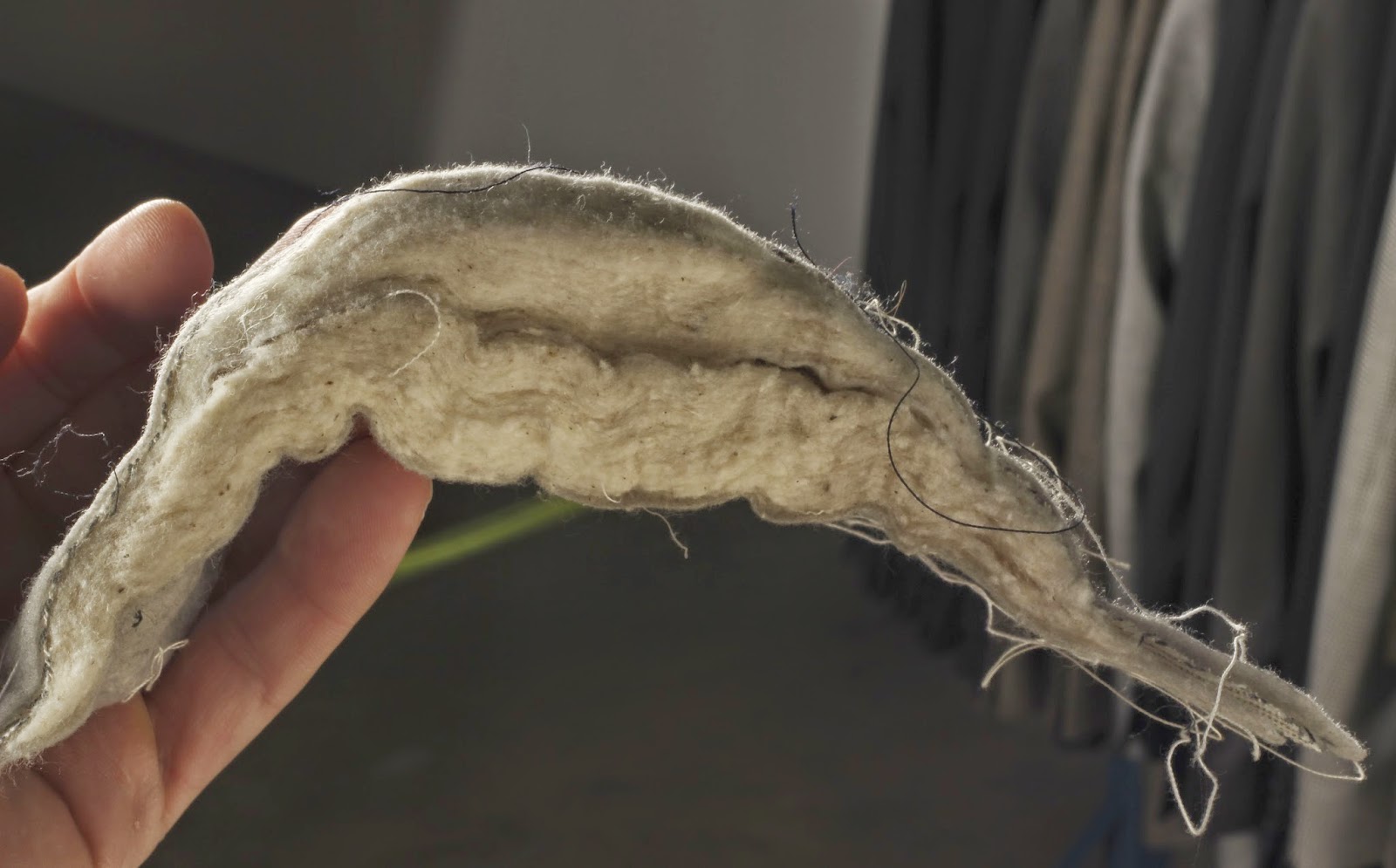
What is particularly interesting in the case of this coat is that the shoulder treatment is something of a hybrid between a "con rollino" treatment and the more conventional one in that the portion of the armhole behind the shoulder seam has been pressed toward the sleeve in the "con rollino" fashion, and the front has been pressed open. I expected the "spalla camicia" treatment since this tailor claims on his website to do it, but perhaps the original owner requested this. It doesn't really matter- it's just interesting from a technical perspective. There is a double-folded, bias-cut piece of domette, the woven flannel sometimes used in the chest area to cover the hair cloth, as a rather bulky sleeve head wadding. Definitely "con rollino". There are two pieces of domette pad stitched together to form a type of shoulder pad- this would give a very soft, supple support to the shoulder area.
Sleeve and shoulder seam allowances-

Sleeve head wadding-

"shoulder pad"-

The wool canvas used in the front of the coat is a much more robust canvas than I would have expected. It is not stiff or firm, but a bit on the heavy side and very densely woven so the front has a lot of support and a decent roll to the lapel. Conversely, instead of haircloth, which is fairly firm, a medium-density hymo has been used in the upper part of the chest and a second layer of wool canvas in the lower part. They are covered in the same domette as was used in the sleeve and shoulder. There is a fairly large chest cut which I feel is necessary to support the drape and give shape to the chest. It is obvious that the cut and construction of the coat were done with softness in mind, but there are indications that the tailor was also concerned with giving some support to the coat so it wouldn't be completely lumpy and messy, as some draped coats are prone to being.


It is not uncommon to add a piece of silesia to the ends of the collar and sometimes the lapel, sandwiched between the cloth and the canvas. I was intrigued instead to find wiggan on top of the canvas (the sort typically used in hems of sleeves), and they weren't pad stitched as one unit, which would be the typical method- removing the wiggan I found that the collar and lapel had been pad stitched first, then the wiggan applied and pad stitched a second time. The facing has been drawn on by hand, something we don't see very often any more, as many feel that the machine gives a stronger, sharper line to the edge. Doing the facing edge by machine, though, requires a good amount of experience to judge the placement of the fullness, since we are working right sides together, sewing from the wrong side. Fullness is a bit like salt in cooking- just the right amount is required; too little and the lapel won't roll, and too much makes for a puckered front. When drawing the facing on by hand we are working from the outside so it is practically impossible to misjudge the placement or fullness, and the shape of the corner at the notch. Peaks especially benefit by this kind of treatment. It is much more time-consuming but much more foolproof than doing it by machine.

The back of the neck is supported by a piece of canvas- this is more typically done with wiggan or silesia. Sandro, my Neapolitan friend, would call this piece a "soffietto", but I never asked him why.

This was clearly made with a lot of consideration given to the internal construction, which makes the visible portions of it all the more puzzling. Pockets, lining, collar matching are easy compared to getting a clean front, lapel and collar, yet those are well done. The back of the sleeve is ugly to my eye but in this it is more of a personal preference. I would much prefer a sleeve which looked like this one done by Steed

to this one

BUT the way these sleeves have been cut will give some additional mobility. The drape in the blades, the soft chest and shoulder, and this wonky, overly long undersleeve all combine to create a garment which I imagine would be VERY comfortable, if a little bit sloppy looking.
Let's sit and think about that one for a while.
Thursday, June 11, 2015
Menefreghismo, part 2- The Guts
Friday, June 5, 2015
Menefreghismo
I struggle to understand this garment. I truly do.
Voxsartoria sent me a suit that he had acquired from the original owner. The coat was made in Naples by a fairly well-known and sought-after tailor, and the trousers were made by an even more well-known trouser maker, also in Naples. It is fairly common practice to farm out work like this.
First, a look at some of the external, cosmetic things. There is so much to the craft of tailoring that is hidden, that it is often said that the few details that are visible must be very carefully executed in order to convey the care (or lack thereof) given to the construction of the rest of the garment. Certain things like pattern matching were once a sign of quality but are now simply expected of even the cheapest ready-to-wear maker. The best tailors will often obsess over the cutting, balancing, matching and boxing of plaids and stripes. Chris Despos occasionally goes to very great lengths to get things to line up and balance, not because he thinks his client will ever notice, but because he is an artist who is concerned about meticulous execution. It is often one of those challenges we give ourselves just to push ourselves and expand our horizons a bit. My patchwork coat was one of those challenges.
I mention all this only to attempt to make the reader understand my intense shock when I am confronted with a garment like this. Whose many outward details were sewn as though by a beginner, or a blind person, or someone attempting to sew with their non-dominant hand. A garment which is easy to dismiss as the work of a charlatan were it not for the fact that some of the less-obvious elements, things which would never be done correctly by a novice, are actually fairly well done. Most of the techniques are very old-school and extremely time-consuming so the outward slap-dash mess is not the result of an attempt to save time. Only effort.
Without effort.
This expression was given as the translation of the Italian word, sprezzatura. It is meant to mean nonchalance, or an unstudied, easy approach to dressing. Carelessness, but in the sense of not having put a whole lot of effort in to one's appearance, but one who just happens to roll out of bed looking well put-together. In this instance, the more literal reading of the world careless would apply. Or menefreghismo, meaning, "I just don't give a shit".
We will come back to this in a subsequent post, having examined the technical aspects of the garment without having given much thought to the somewhat more intangible aspect of how the garment might affect the wearer's state of mind.
So. My first impressions?
A disaster.
This is important and will come back to us later.
Readers will have noticed that though my normal practice is to identify the maker, in this case they will remain nameless so as to avoid the appearance of my having a particular bone to pick with either of them and I certainly don't want to negatively affect their iReputations. This is merely an examination of the work of two of the more notable tailors in a city which many hold to be the best city in the world in which to find a tailor.
The collar. Pattern matching is generally expected here. #FAIL

I have never been a fan of Neapolitan buttonholes. I think they look sloppy and flat and uneven. I can spot a Kiton from ten feet just by the squashed beetles on the front of their coats. These are classic examples. That being said, this is a matter of pure personal preference; they might think that my buttonholes are rigid and lifeless. Or something. So there is nothing necessarily incorrect about these, I just don't like them.


The flap pockets, however, are a disaster. Period. Never mind the need to match the stripes, which any novice knows to do, the pockets are not even cut on grain. The corners are dog-eared, the pocket lips are uneven and messy, there is a gap between the end of the flap and the pocket, and the half-moon tacks at their ends are ridiculous. The technique that was attempted is generally regarded as the correct one, but they failed miserably in the attempt.


Even more lamentable is the interior. The finishing of the lining, though done by hand, and the interior pockets, equally done by hand, are atrocious. I have never seen something so bad, ever.
EVER.
Click on the images for a closer look at the carnage.


Instead of conveying care and attention to detail, the visible details of the coats are unequivocal. Non me ne frega un cazzo, they say.
I think this is a good point at which to pause in the dissection. Critics were just as harsh in their initial appraisals of impressionism and cubism and dadaism: there is perhaps more going on here than just mismatched stripes and ugly pockets. Maybe. We will look next at the guts of the garment, most of which will be lost on anyone who is not an experienced tailor, but which might provide some insight anyway. Then we will hear from the tailor himself, a story translated from his own website which gives even more to think about. And a reminder I often repeat to myself and some of my colleagues.
We're not curing cancer, here. They're just clothes.
Wednesday, June 3, 2015
Sprezzatura 2.0
Wikipedia defines Sprezzatura as follows:
an Italian word originating from Baldassare Castiglione's The Book of the Courtier, where it is defined by the author as "a certain nonchalance, so as to conceal all art and make whatever one does or says appear to be without effort and almost without any thought about it".
I find it somewhat amusing that the writer should use a foreign (French) word, nonchalance, to help define another foreign word, but there it is. Without effort.
The next three or four posts will be an exploration of this concept of sprezzatura, or without effort, and its Italian cousin, menefreghismo, which is a somewhat coarse way of saying "I don't give a ...damn". The French and Italians not only have a word to describe it, but a gesture to punctuate it as well. The famous Gallic shrug. In Italy the gesture is similar but perhaps more emphatic. The closest we get to it in America is probably "whatever, dude."
Voxsartoria long ago promised me a suit of his for dissection. I won't mention who made it but if you have followed his numerous internet incarnations, you could probably figure it out. The coat was made by a fairly well-known tailor, and the trouser was sub-contracted to an even more famous trouser maker but sold under the label of the first. Both are located in Naples, one of the few stylistic regions that I have not discussed much in this blog, so this promises to be interesting on many levels. Partly because it prompts one to think a lot about sprezzatura, both in how one approaches style, but also how one approaches ones work or craft. It also becomes a reflection on luxury, exclusivity, and the talismanic power certain items can have over our behavior and mindset.
Friday, May 22, 2015
SMALTO REDUX

Francesco Smalto, pictured above, passed away last month.
I once had the opportunity to examine one of the coats made in his Paris atelier, and posted a video showing some of the work being done. Those who fetishize hand work should absolutely love his stuff, though the styling may not be for everybody.
Kirby recently reached out to me to offer another, more recent example of their work, Kirby of the Hanger Project, whose website sells luxury wooden hangers and Saphir shoe polish. Yes, I am willing to trade links for bespoke clothing.
This example was made for a member of the royal family of the country in which Smalto was residing when he passed away, and whose taste in clothing can be said to be somewhat flamboyant. A 3 on 3 double-breasted model with a huge amount of padding in the shoulders, and a rather firm chest, cut out of a stripe which we might normally associate with trousers to be paired with a morning coat. The photo below is of me modeling the coat.

Their house label set in their trademark teardrop pocket, one of the little touches that at once speak of uncommon attention to detail and an attempt at "luxury branding". The back of the pocket is also shown.

The bottom of the center vent is tacked by hand with the trademark S for Smalto, a little touch that I like.

Other details which are unusual to see in bespoke clothing but are typical of luxury houses are branded jacquard linings, and corozo buttons with FRANCESCO SMALTO etched in the back.

The client's initials are hand embroidered on the lining, in addition to the usual label inside the pocket with the client's name, order number and date of order (not shown).

The buttonholes, as expected, are good, but I have seen better examples of the boutonnière milanaise


The lining has been entirely inserted by hand with a semi-decorative stitch. Here is shown the inside of the vent.

Now for the more nerdy stuff.
As we saw on the last example, the top collar is done in two pieces, a bit of engineering not commonly found in bespoke tailoring.

All the seams have been overcast by hand, which is somewhat unusual as one might expect to find them either pinked or serged which would be much faster than doing it by hand. But I respect their choice. The lapel and collar, on the other hand, have been padded by machine, then the edges taped rather carefully by hand.


The chest, however, has been very thoroughly padded by hand on both sides.

An absolutely enormous amount of wadding in the shoulder but a light, single-ply piece of canvas in the cap of the sleeve-


And a very liberal amount of haircloth in the chest.

Students of tailoring should take note of the split, or vee, in the smaller piece of haircloth along the roll line- the fullness created by doing this is carried over the shoulder point, though this split is normally applied neck to the neck and not quite so far down the chest.
To avoid the vees we usually see in the shoulder part, the canvas has been seamed along the hollow part, not only to create the necessary length over the shoulder point, but to rotate the hairline in that part on to a semi bias. This creates some give over the shoulder but also some support- it is common to turn the haircloth piece in the shoulder on a similar angle. What is not clear to me is the purpose of the cross-cut piece of inch-wide haircloth running straight up the hollow part of the front shoulder. This may be due to a particular shape on the client's anatomy.

Very wide outlets have been left on the shoulder seam-

The back neck and armhole have been stayed with lining instead of silesia (or, as we will soon see from a Neapolitan tailor, canvas)


The vents are reinforced with wiggan, which has been felled, along with all the hems, with an extremely fine thread and a very delicate stitch. Someone in their shop has very good hands.

Overall the workmanship is excellent, with an inordinate amount of attention to detail overall, something which should lend Paris' tailors a much higher level of esteem on the world stage- by comparison, many of the better-known Italian houses are over-rated. But that will be the subject of another discussion, coming very soon, thanks to a long-awaited donation by voxsartoria...
Friday, May 15, 2015
J.K. Wilson on Drape
Carpu65 posted a page from an issue of the Tailor and Cutter magazine from 1954. It is an article by J. King Wilson on his recollection of the drafts of Frederick Scholte, the "inventor" of the Drape cut.

He admits that his memory may be a bit fuzzy, but this draft is interesting nonetheless, for several reasons. He gives the size as a 40" chest.
The half waist is approximately 21", one can't say for sure since the dart and overlap measures are missing; it's generous but still within the realm of an ample size 40. The neck point is located 4 1/2" from the scye, which is roughly an inch of drape by my calculations. No surprise there. The point-to-point is a whopping 20", which is not surprising given the purpose of the drape was to give the appearance of broad shoulders and full chest above a trim waist, and there is 3/4" fullness in the shoulder compared to the 3/8" that was commonly given in Wilson's but I'm curious that there appears to be little to no drape in the blade. I would have expected some here , given what other drafts and certainly what other tailors who make some version or other of the drape cut, but it is possible that Scholte, whose purpose in cutting was aesthetic and not functional, may not have given much drape to the blade. I don't remember having seen a decent back view of any of his coats. The drape in the blade may have been a later addition, or else it is a mistake on the part of Mr. Wilson as the article was written about seven years after Scholte's death, and perhaps 20 years after the height of the drape cut's popularity.
Tuesday, May 12, 2015
My shears came!
Friday, May 8, 2015
The End of an Era in Padova
Zegna has closed its Padova factory, the one that was producing the Zegna Couture and Tom Ford products, both of which I thought were superbly made. 230 people were to be put out of work, with an offer of a transfer to other locations (production is being transferred to a plant in Novarra). On the bright side, that means there will be highly-skilled technicians available to be scooped up by manufacturers around the world who might need help.
Full article at
http://corrieredelveneto.corriere.it/veneto/notizie/economia/2015/28-marzo-2015/sartoria-padovana-finisce-un-era-zegna-chiude-l-azienda-rubano-2301175696311.shtml
Sartoria padovana, finisce un’era
In.Co chiude l’azienda di Rubano
A casa 230 persone. I sindacati sul piede di guerra: «Lunedì assemblea»
RUBANO (PADOVA) Narrano che tra gli anni Cinquanta e Sessanta ci fossero vere e proprie gare tra i sarti del Padovano per entrare in quelle sacre mura. La Gival era la bottega trasformatasi in azienda professionista nell’alta classe, nelle giacche e nei pantaloni eleganti. Ago, stoffa e filo di altissimo livello, il sogno di un’Italia che usciva dalla guerra e si faceva bella non solo nel giorno di festa. Ebbene, a più di sessant’anni dall’inizio dell’avventura, adesso tutto finisce. Claudio Ronco, responsabile della supply chain della divisione abbigliamento del gruppo Ermenegildo Zegna (che dal 1996 è subentrato con la Spa In.Co alla Gival) ieri mattina ha annunciato la cassa integrazione guadagni ordinaria per quattro giorni la settimana fino al 9 maggio. «Di fatto, chiudono lo stabilimento di Sarmeola», taglia corto Angelo Levorato, che segue la vertenza per la sigla di reparto della Cisl, la Femca. Resteranno senza lavoro poco meno di 230 persone, la maggioranza sono donne di mezza età . A tutti, è stato offerto il trasferimento in altri poli produttivi italiani.
«Ma è impossibile spostare donne con famiglia», tuona Levorato. Il gruppo infatti adesso vuole spostare l’alta sartoria del capospalla maschile nel nuovo centro di San Pietro Mosezzo (in provincia di Novara), costato 20 milioni di euro con obiettivo 600 occupati grazie a 200 assunzioni. Le motivazioni addotte dall’azienda per l’addio a Padova sono legate alla contrazione dei mercati russo e cinese, dove il modo di vestire maschile è sempre meno formale. Tradotto in numeri: servono 300 capi al giorno per mandare avanti lo stabilimento , che oggi è ridotto a 120 e l’ultima campagna di vendite (chiusa nella prima settimana di marzo) non ha dato gli esiti sperati. Così, i dipendenti da lunedì affronteranno la cassa integrazione, che durerà fino al prossimo 9 maggio.
Poi si vedrà . Sul piatto, per tutti, sono stati promessi posti di lavoro a Novara, ma anche a Biella e Parma, negli stabilimenti che si occupano di outwear, abbigliamento in pelle e accessori. Lunedì è programmata una nuova assemblea sindacale a partire dalle nove del mattino, che si annuncia infuocata dopo lo choc di quella di giovedì mattina. «Ma a meno di un miracolo, la proprietà non torna indietro », taglia corto Levorato. Si chiuderà così nei prossimi giorni una pagina storica della sartoria veneta. La Gival infatti era arrivata ad avere fin quasi 500 dipendenti e nel segmento alto dell’eleganza classica, quella amata dall’uomo d’affari, aveva pochi competitors nel Nordest. Una storia che, invero, aveva già avuto una sua prima «morte» nel 1996, con quel concordato preventivo che permise al gruppo Zegna di comperare anche lo stabile. Al tempo c’erano 400 dipendenti, che vennero ridotti a 150 per poi tornare a salire, nell’ultimo ventennio, anche fino a 300
Friday, May 1, 2015
Classic Tailoring Techniques for Menswear
The long-awaited revision of what is perhaps the definitive English-language textbook on traditional tailoring techniques (at least of those currently being published) has been released.

Classic Tailoring Techniques for Menswear is a textbook published by Bloomsbury Publishing, and has been revised by Denis Antoine, a teacher of menswear at the Savannah College of Art and Design. While other publications may be more thorough treatments of the subject, books like those written by the late Stanley Hostek are not as clearly presented for the novice, and the coveted Modern Tailor, Outfitter and Clothier have been out of print since the 1950's so complete, three-volume sets are comparatively rare and expensive. Then there is R. Doyle's The Art of the Tailor, which seems not much more than a copy-and-paste job by an enthusiastic but misguided amateur who may be waltzing very near the edges, if not trampling directly upon the Berne Convention. The bibliography lists a number of other titles which may be useful to the student, as well as a few supply sources.
I have often said that learning tailoring from a book is somewhat akin to learning to play piano from a book, but for those who have no access to a teacher this is as good a place to start as any, and it is certainly a very good accompaniment to any formal course of study.
Chapters include the following:
1- Tailoring (history, supplies and basic techniques)
2- The pattern (measurements, patterns, preliminary adjustments)
3- The fit (toile or muslin fittings and pattern adjustments or "blue pencil")
4- Fabric (weights, patterns, etc.)
5- Layout and Cutting (matching stripes and plaids etc.)
6- The Jacket-
Darts and Seams
Ironwork
Pockets
The canvas
The facing
The lining
Shoulders
The collar
The sleeve
Buttons and buttonholes
7- The Pants
Ironwork
The crotch
Pockets
Fly
Side seams
Waistband
Hem
8- The Vest
9- Alterations
700 new photos and illustrations are included in this revision and one of the most helpful aspects is the addition of color to the diagrams which help enormously with the clarity of the instructions. Some of the photos are somewhat dark and slightly fuzzy, but I am well aware of the difficulty of photographing this type of thing and am not sure how it could be done better. On the whole, though, the graphic representations of the steps involved are one of the great strengths of this book and are of enormous value to the student or beginner

New to this edition is a discussion of ironwork. The photos illustrating the technique are not super clear, but I happen to think that this is something best learned at the hands of a teacher and at least the book broaches the subject so that students are aware of the principle and the need for it so it is an improvement on the previous edition.
The methods presented are probably one of the better systems for the beginner, avoiding many of the personal quirks and regional variations that tend to plague other forms of instruction, whether in print or in newer video format. There are as many ways of constructing a coat as there are tailors, but I feel the book presents methods that would be easily adapted to most workshops rather than idiosyncrasies that lend personal flavor to a garment but are best left to experimentation and discovery once the student has a firm grasp of the basics.
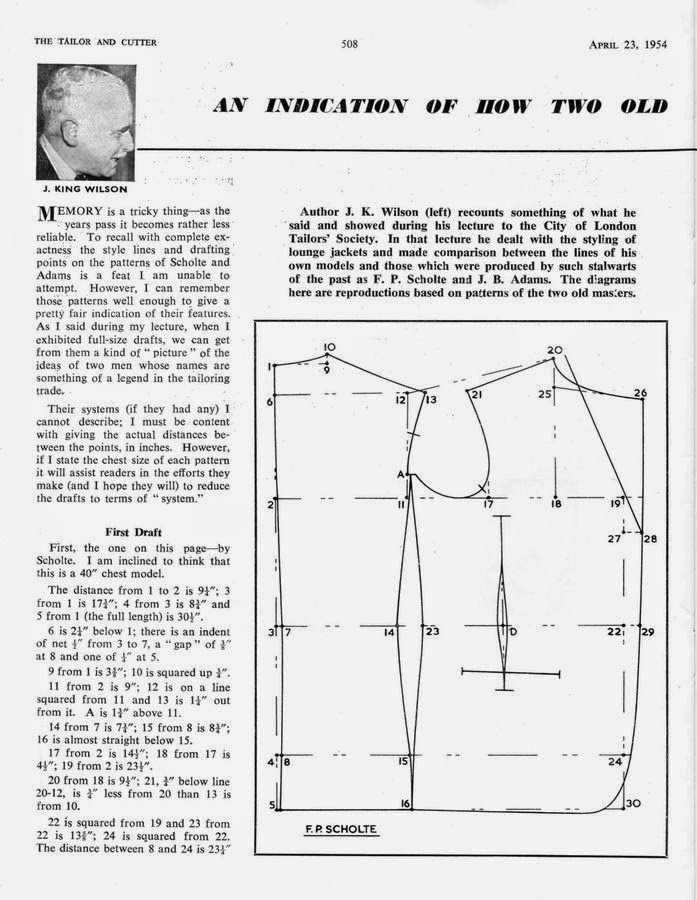
I am somewhat perplexed, however, by the treatment of collars. The text discusses the use of the collar pattern that may have been provided with whatever commercial jacket pattern was being used, and has good instructions for drafting a collar pattern, save for one error in the final steps of the draft. Though useful for advanced tailors and certainly for people working in the RTW industry, I think that the more traditional method of shaping the under collar would be more in keeping with the overall subject of the book. Rather than using a pre-shaped pattern for a collar, a blocked under collar is typically attached to the coat with a fair amount of extra width on it once the facing has been attached. The collar is then shaped either freehand, or better yet, using a paper shaper, and the excess is trimmed away; using a pre-shaped under collar requires a very great deal of precision when attaching it in order to have a perfectly even and symmetrical shape from one side to the other. Helpful patterns for parts like pocket and fly pieces are included at the back of the book, and I feel that shapers would have been a very good addition to these, especially since they were often included in earlier books aimed at the professional, whether for use in traditional tailoring methods or for drafting paper patterns for wholesale. A sample of these shapers can be found near the back of the Modern Mitchell System of Men's Designing-
Space, time, or other restrictions may have dictated this, as well as the one-page treatment of final pressing, something which I feel deserves and entire chapter, if not an entire book. Again, the author may have felt that these were things best learnt in their entirety at the hands of an experienced practitioner rather than trying to explain them poorly in print.
The book is not exactly cheap, though textbooks never are, so if you own a previous edition of it I don't think I would upgrade to this latest one. It's a book, after all, not an iPhone. But if you don't have a copy and are learning, or trying to learn, the complex craft of tailoring, I consider this new edition of the text to be a must-have in your library.