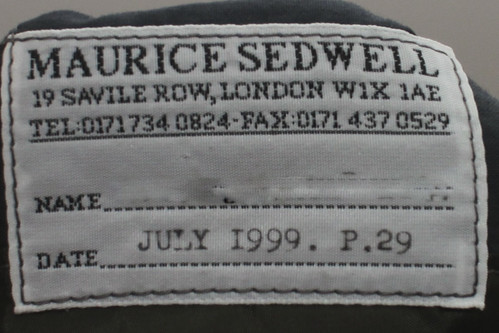
The latest sample I purchased on ebay thanks to a tip from RJMan.
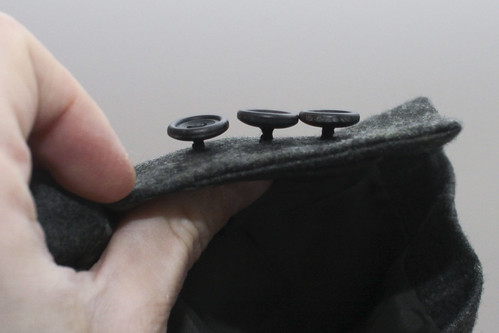
Maurice Sedwell enjoys an excellent reputation and its proprietor, Andrew Ramroop, is very keen on explaining the many reasons why. Of course, one of the first things I look at when examining a garment are the buttonholes and buttons, and these are very good. The buttons have been beautifully shanked and stand up to attention like a row of horn soldiers.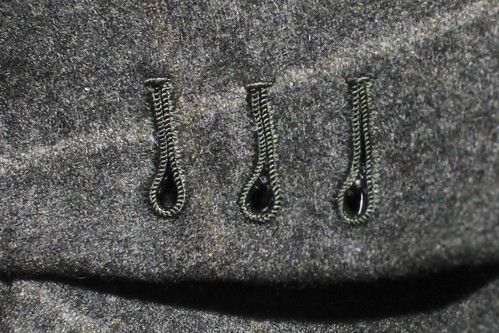
I noticed some light grey thread peeking through the underside of the buttonholes which I found a bit puzzling.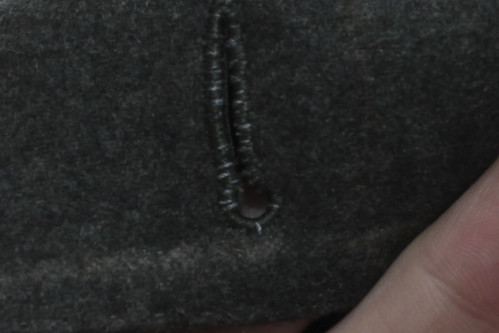
I unpicked one of them and found that the buttonhole had been meticulously overcast prior to working it up. Why they did it with light coloured thread is anyone's guess, but at least it was carefully done and does not show on the right side.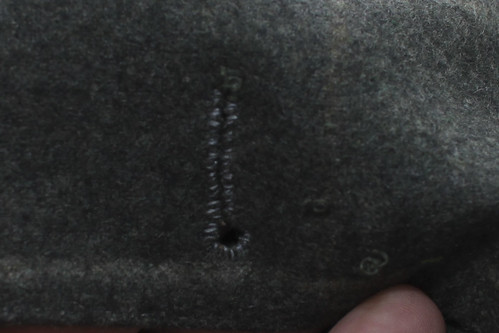
The way he has matched the flap to the coat is somewhat curious. Darts often distort the pattern above the pocket so it is most common to match the flap to the lower part of the coat. In this instance he has matched to the top part, behind the flap. I'm not a fan.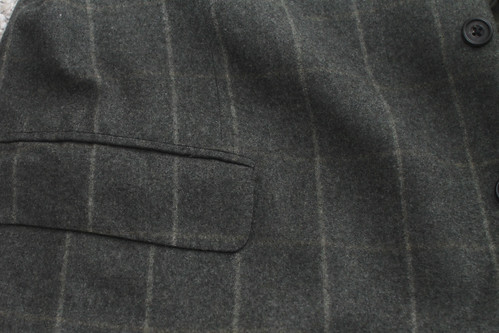
Inside the pocket, he has created a pleat which should help prevent the pocket gaping open when the owner shoves things in it.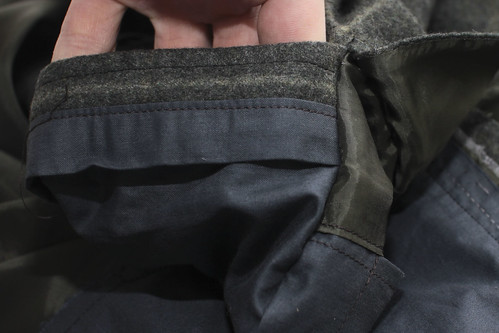

The inside lining has marks that indicate the the garment has been altered so there may be a few question marks.
The lining itself has been inserted by hand, something which few West End tailors do anymore. It's been reasonably neatly done, far better than the Fallan and Harvey coat.
A piece of linen holland has been used to turn the edge of the undervent, however this was completely concealed by the lining.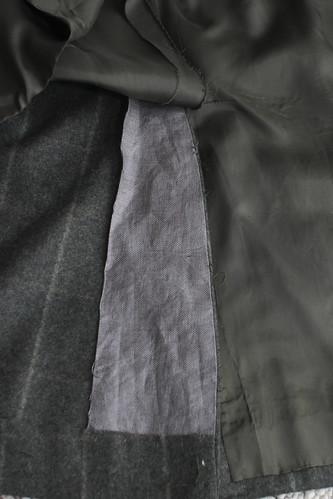
The back hem has been reinforced with weft-insertion fusing.
Since the front hem has been done with linen holland, I think it is safe to assume that this was done by the alterations tailor.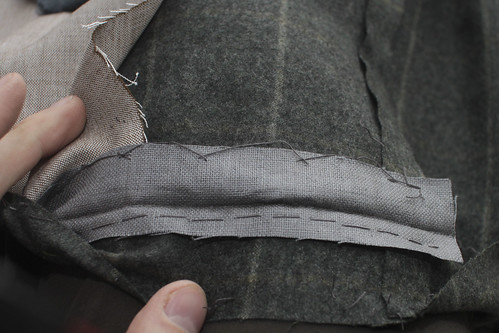
It is no surprise that the chest, lapel and collar have all been padstitched by hand, and a piece of silesia has been laid over the lapel canvas prior to padstitching. The edges have been stayed with linen holland in a method that looks to me like the one used by canvas garment factories.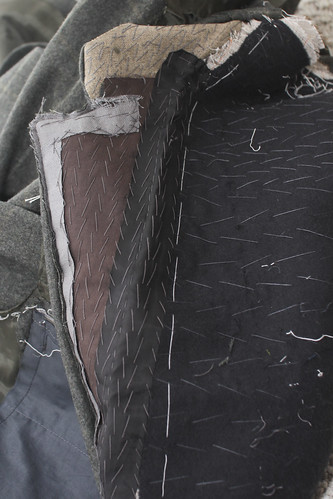
The facing has been applied by machine, and the linen is caught in that seam. I will have to unpick the tape to know for sure if he has done what factories now do.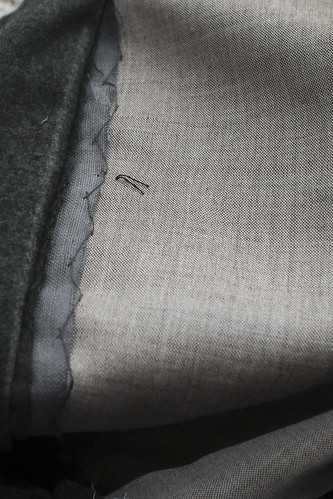
And yes, there it is, the gap between canvas and seam.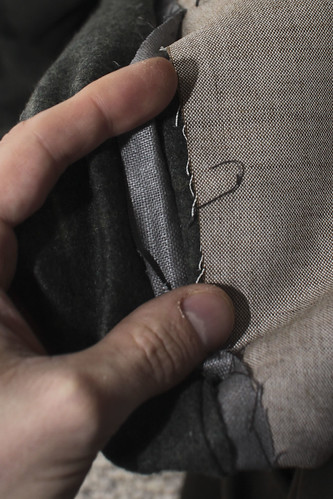
In order to reduce bulk in the edges, we trim away more canvas than is traditionally done. Once the front has been shaped (the excess cut away to the proper shape, leaving only the seam allowance of 3/16" or 1/4") we trim away the canvas not to the seam line as used to be the method, but double the value of the seam. For example, if the seam allowance is 1/4" we will trim 1/2" of canvas away. We sew at 1/4" then turn the seam allowance inside to fill the gap between edge and canvas. The tape is caught in the seam which will prevent the canvas from moving. This technique is most useful on very fine cloth where the added thickness of the canvas at the very edge is not to be desired.
Back to Savile Row.
There is needle-punch foam in the sleevehead, similar to what is used by manufacturers, and the shoulder pad is prefab. The sleeves have been set by machine, and the shoulder seam has been sewn by machine. It's becoming increasingly clear that the number of people who think that it is necessary to do these steps by hand are a distinct minority.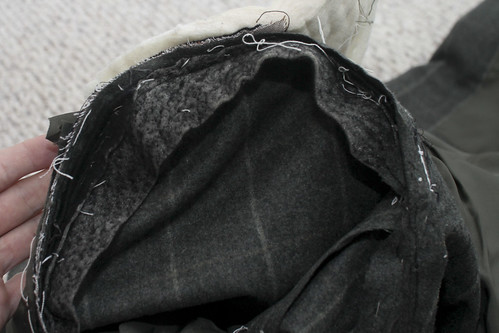
When I got to the chest I could tell that there is only one layer of wrapped hair hymo in the chest, rather than proper haircloth so I didn't go to the trouble of unpicking it all. I have very mixed feelings about this. On the one hand, it is much softer than haircloth and if the customer wanted something very soft, then it's not a bad choice. However I would still have put a haircloth (or even hymo) reinforcement in the shoulder, and there is none. There may be a reason for this as well, which we will never know.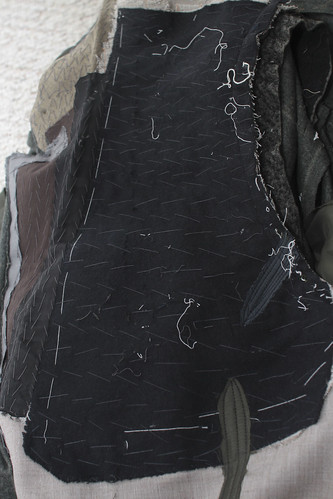
So is Maurice Sedwell the best on Savile Row? Inconclusive. This is certainly the best Savile Row garment that I have handled but one can't make sweeping generalizations based on a handful of garments. Were I in the market for a tailor in London's west end, I would certainly call on Mr. Ramroop to have a chat.


 Posts
Posts



21 comments:
Thanks for that; always wanted to see one of his coats cut up. Im quite surprised shoulders and sleeves not hand sewn, but then it does have more than most on Savile Row.
I'm surprised that the facings were sewn on by machine. In the BBC series, Mr. Ramroop said they did the facings by hand. I'm also surprised about the shoulders and sleeves.
Also interesting to see that the lapel had the silesia on top, as opposed to underneath.
You were right about the buttonholes. Interesting the the straight part curves a bit. Is there any reason for this?
What was the coat's overall silhouette and style like? Some SR tailors like Huntsman or A&S have their so-called house look so that clients generally know what they will get beforehand and wondered what Sedwell done with this coat.
- OR
I am currently a 28 year old American tailor apprentice under a maestro in Italy. I adore this art completely. I am trained under the old tradition where we do everything by hand, set the tape by hand, padstitch by hand, place the collar by hand, and even fall the lining by hand. The only things we do by machine are the side seams, pocket seams, shoulder seams, and arm seams. Both the shoulder seams and the arms seams are basted thoroughly before being placed. I greatly appreciate this blog and am glad to see that there is still a great following of this art.
You say that "This is certainly the best Savile Row garment that I have handled". Is that good enough considering the price? I am a little surprised.
Fran
I recently watched a YouTube video posted on CutterandTailor that features Maurice Sedwell. This is so timely, thanks again for taking the time to do this, I'm learning so much.
@brendan- Indeed. They obviously see no value in it.
@Benjamin- Perhaps he meant the joining of the lining to the facings. Or perhaps that they have changed and now do it by hand. They curve a little from use, and because you never get two buttonholes exactly alike. What's that japanese word?
@OR- impossible to know about the silhouette without seeing it on the wearer. It's a 2 button, side-vented coat cut for someone of generous proportions.
@Anonymous- glad to hear that the craft is being passed along! Good luck with that! (Piuttosto, tanti auguri!)
@Anonymous- I'm not sure what you mean? And I'm not sure what the price was.
@Kim- a pleasure, as always.
I think Maurice Sedwell suits run less than 2500 GBP, and that's AFTER the VAT.
Benjamin, a 2pc suit is far higher nowadays, probably only second to Huntsman in price for SR tailors.
- OR
@ Occam's Razor - you are indeed correct; they are now 4500 GBP. I must have been working off an OLD article.
I sent an email to Maurice Sedwell asking about the facings, shoulders, and sleeves. The response was that they were all done by hand. Could this have been a rush job for an apprentice? Applying the facings by hand takes a long time. The shoulder pad is also a pre-fab, but I don't know how much time that would save.
This is the cutter's blog at Sedwell:
http://davidetaub.blogspot.com/
He's the best SR cutter that I used and very open to collaborating and working on new ideas as you can see on his blog. I think he is very talented.
- OR
@Benjamin E.- I think it is more likely that this dates to a period when they were less expensive and the methods reflect this. It is also possible that subcontractors were used (they all do it- it's nota big secret).
@OR- thank you- thank looks interesting.
Just wondering, is it better to pad stitch a lapel/collar with silk thread or mercerised cotton? I have seen some bespoke use real silk thread but is it really needed? Which do you prefer to use? thanks for your opinion
@brendan- I don't think it really matters what kind of thread you use to pad stitch the collar, and for the lapel a finer thread will leave less impressions but will knot more easily when working unless you wax it. I don't think silk is needed for those steps.
Thanks for your expert opnion on the matter. I never thought about waxing thread before, sounds like a great idea. Ive always had problems with thread knotting, its a pain!!
i am of the opinion that top Italian and American besopke tailors have surpassed standards of Savile Row tailors - SR is living on past glories and others have jumped ahead of them in terms of quality and finishing
Hello all, I'm currently studying under Andrew on Savile Row. Just to answer a few questions - The facings are all sewn by hand , trust me, my fingers know of the painstaking process all too well!
In regards to subcontractors - NEVER! I see every garment start its life in the front of the shop, through to the cutting room and on to the customers back. I chose to study at Maurice Sedwell because of the fact that everything is done in house and on Savile Row.
It also pays to know that every tailor in Maurice Sedwell has to be trained by Andrew before they get a job :D This is all except George and Morris who are both touching 75 and started tailoring at the age of 12. I know, crazy.
George is a big inspiration and was asked recently to make the gold threaded suit on display in the shop - all welcome to come and see it, it's incredible!
Only visiting this site for the first time and am very interested in all the comments. The jacket in question was made by Maurice Sedwell for a New York customer (deceased) that was very corpulent. He became very ill not long after taking delivery and lost around 24 lbs. The garment must have been altered. A lot has changed since this company made that jacket in regard to hand sewn seams. The questions are too old for me to respond to but if there are any new questions that are relevant to craftsmanship, I would be pleased to respond when next I visit this site. But for now, you would have a great deal of trouble ripping down one of our latest offering...Andrew M Ramroop
In regard to the use of subcontractors:
There are a total of 23 bespoke tailors throughout England that do everything in-house 90-100% of the time. Of course, 0-10% of the time, as little as half of all of the manufacturing, other than all cutting, is done in-house.
The 23 tailors that do everything in-house 90-100% of the time will have outworkers do as much as half of all of the manufacturing, other than all cutting, 0-10% of the time.
Everything in the previous two paragraphs always has been and still is the case for 23 bespoke tailors throughout England. Those 23 bespoke tailors never have had and still don’t have apprenticeships.
Before Kathryn Sargent became an Associate Member of The Savile Row Bespoke Association also had the combinations of all work, other than all cutting, done by outworkers, and work done in-house, as described in the paragraph above. Nick Tentis started permanently doing everyone in-house on or around his 35 year anniversary in 2026.
On average, 23 bespoke tailors throughout England do everything in-house 95% of the time. On average, five percent of the time, 23 bespoke tailors have outworkers do 1/4 of all work, other than all cutting, with the remaining 3/4 done in-house.
In regard to subcontractors, part 2:
I’ve now personally had various forms of communication and contact with 92 bespoke tailors throughout England.
These 92 bespoke tailors throughout England do everything in-house! 😉
They have extremely strong reputations and have far too much to lose, absolutely NOT, in any way, monetarily, to tell anything other than outright truth! 😉
Bespoke clothing and footwear making of all kinds imaginable is the ultimate in taking a lot more than it gives back, especially in the monetary sense! 😉
With bespoke clothing and footwear making of all kinds imaginable, integrity is the absolute most indispensable of any occupation imaginable that there is! 😉
They absolutely cannot afford to lack integrity and tell anything other than outright truth! Much more so than all workers imaginable in all other occupations imaginable in existence! 😉
So, therefore, I absolutely know for a fact that the 92 bespoke tailors listed below are absolutely telling nothing other than outright truth when they say they do everything in-house! 😉
Here’s the list of the 92 bespoke tailors throughout England that do everything in-house:
1. Alexander & Rathor
2. Phillip Alexander
3. Charlie Allen
4. Anderson & Sheppard
5. Richard Anderson
6. Caroline Andrew
7. Antich Fine Tailors
8. Bailey & Brummell
9. Sir Tom Baker
10. Jeff Banks
11. Banshee
12. Barucci Custom Tailors London
13. Bateman Ogden
14. Beespoke Tailoring
15. Benson & Clegg
16. Bespoke Tailor Studio
17. Black Butterfly
18. Ozwald Boateng
19. Jacob Brian Leeds Tailors
20. Cad & The Dandy
21. Capital Bespoke Tailoring
22. Casual Fitters London
23. Chittleborough & Morgan
24. Cifonelli London
25. Clements & Church
26. Clothsurgeon
27. Comelie
28. The Cotswald Tailor
29. Davies & Son
30. Dege & Skinner
31. Drake’s
32. Dugdale Brothers & Company
33. Ede & Ravenscroft
34. English Cut
35. Timothy Everest
36. Fox Brothers & Company
37. Michael Frackowiak
38. Fedro Gaudenzi
39. Gieves & Hawkes
40. Matthew Gonzalez
41. Gormley & Gamble
42. Hackett
43. Harrison’s 1863
44. Douglas Hayward
45. The Hidalgo Brothers
46. Holland & Sherry
47. Huddersfield & Company
48. Huntsman
49. Richard James
50. Paul Jheeta
51. Kale Bespoke
52. Kent, Haste & Lachter
53. King & Allen
54. Knatchbull
55. Lawton
56. Jasper Littman
57. Lovat Mills
58. Lee Marsh
59. Katherine Maylin
60. Desmond Merrion
61. Meyer & Mortimer
62. Mirpuri Bespoke Tailors
63. Abraham Moon & Sons
64. Morgan & Fenwick
65. Nooshin
66. Norton & Sons
67. Norton & Townsend
68. Marc Oliver
69. Orhan London Tailoring
70. James (Pendleberry) Personal Tailor & Son
71. Henry Poole
72. Redmayne 1860
73. Redwood & Feller
74. Jojo Remeny
75. Roberto Revilla
76. Kathryn Sargent
77. Scabal
78. Owen Scott Bespoke Tailors
79. Maurice Sedwell
80. Edward Sexton
81. Nicholas Simon
82. Anthony Sinclair
83. Steed
84. Carl Stuart Bespoke Tailors
85. Thom Sweeney
86. Ray Stowers
87. Strickland & Sons
88. Tailor Made London
89. Nick Tentis
90. Welsh & Jefferies
91. Whitcomb & Shaftesbury
92. Alexandra Wood
I accidentally posted as anonymous just now with the list of 92 English bespoke tailors that don’t use subcontractors, where they actually frown upon it. I apologize for not using my real name for the second message that I posted in this article. 😢☹️😞
Post a Comment