Showing posts with label Samuelsohn. Show all posts

Friday, January 10, 2020

"Robert Jeffery"


Wow.  It's been 12 years since I started this blog. The focus has shifted over time, and I seem to have been writing less and less, mostly since life happened and I got busy (and married) and moved all over the place.  I feel the time is right to devote more time to blogging again, especially since I now have help.

The first major thing to talk about is the migration from Blogspot/Blogger and Flickr, etc. to my own site.  Sites like Blogspot are great because they are free and easy, but you don't really own your content (you get what you pay for).  Sadly, a lot of my photos in older posts are now lost because some photo hosting sites decided to change the terms and conditions.  I considered moving over to Instagram but that's just another place where you are at the mercy of someone in San Francisco.  The other thing is I have a lot of new projects on the go and I think it's time I consolidated everything into one spot.  So my new website, which is still being developed, can be found at robertjeffery.us. "Robert Jeffery" is also the name of the company I formed last year. 



The Tuttofattoamano/Made by Hand blog will be hosted under this umbrella, as well as a few related sites like my ladies wear (The Louise Collection), and an activewear collection to be launched later this year.  So I apologize for any inconvenience if you have come looking for old articles on Blogspot which you can`t find anymore but hopefully the new blog site at robertjeffery.us will be far more searchable so you can find old stuff more easily.

So what have I been up to lately?  I'm still happily busy at Hickey Freeman in Rochester, New York, but have been traveling back and forth to Montreal every week, spending time at our Samuelsohn facility, where we have made suits for almost 100 years, and recently also began sewing shirts, as well as a Canadian brand of outerwear called Moose Knuckles.

For almost a year now I have also been working on some new technology to draft patterns from body measurements with the intent to modernize made-to-measure (MTM).  I know there are tons of websites out there that claim to already make custom patterns from photos and body scans but I have yet to see technology that I would actually want to use and hang my reputation as a tailor on.  So I teamed up with some clever people in Europe who had already begun working on something and we will begin live beta testing in the very near future.  More on that soon.

Last summer I accidentally started a line of ladies tailored clothing.  By "accidentally", I mean I wanted to put together a little group of ladies' suits as a tribute to our late congresswoman, to be shown at a charity fundraiser in Rochester.  It didn't occur to me at the time people might actually be interested in buying the stuff, so we had to quickly cobble together a company and a website to make the line available publicly.  The Louise Collection belongs to Robert Jeffery, LLC, and is being produced at the factory that makes Hickey Freeman in Rochester.  Right now it is only made to measure, by appointment, but we are considering bringing it to a wider market through carefully selected retailers in the United States and maybe eventually Europe.


I couldn't have done any of that without the help of my husband, who is the director of operations for Robert Jeffery.  He is handling the website(s), the book keeping, billing, scheduling, daily operations, and is also my in-house Salesforce system admin.  A former competitive bodybuilder, he's always had trouble finding clothes, and I have always had trouble getting him into suits, which is a bit of a shame considering... Like the aforementioned technology, there are products on the market which purport to be made to fit athletic guys, but again, I found most of them lacking.  And the good ones in Europe and Australia are either super expensive to have shipped to the US, if they will even ship at all, and don't extend into the larger sizes needed by big American boys.  So he decided we should launch a line of activewear and athleisure for that specific market.  To the extent that the market will permit it, we want to have most or all of it made in the United States.  Again, more on that in due course.


So with all that said, I'll stop posting here on Blogspot - go check out our new home on the web at https://robertjeffery.us/tuttofattoamano/

[Please go to the new Tuttofattoamano to comment]

StumbleUpon.com

Monday, September 28, 2009

Brioni vs. Samuelsohn- the hand-sewn lapel

Going back a bit again to the Brioni coat. This blogger may need Ritalin.

gorge

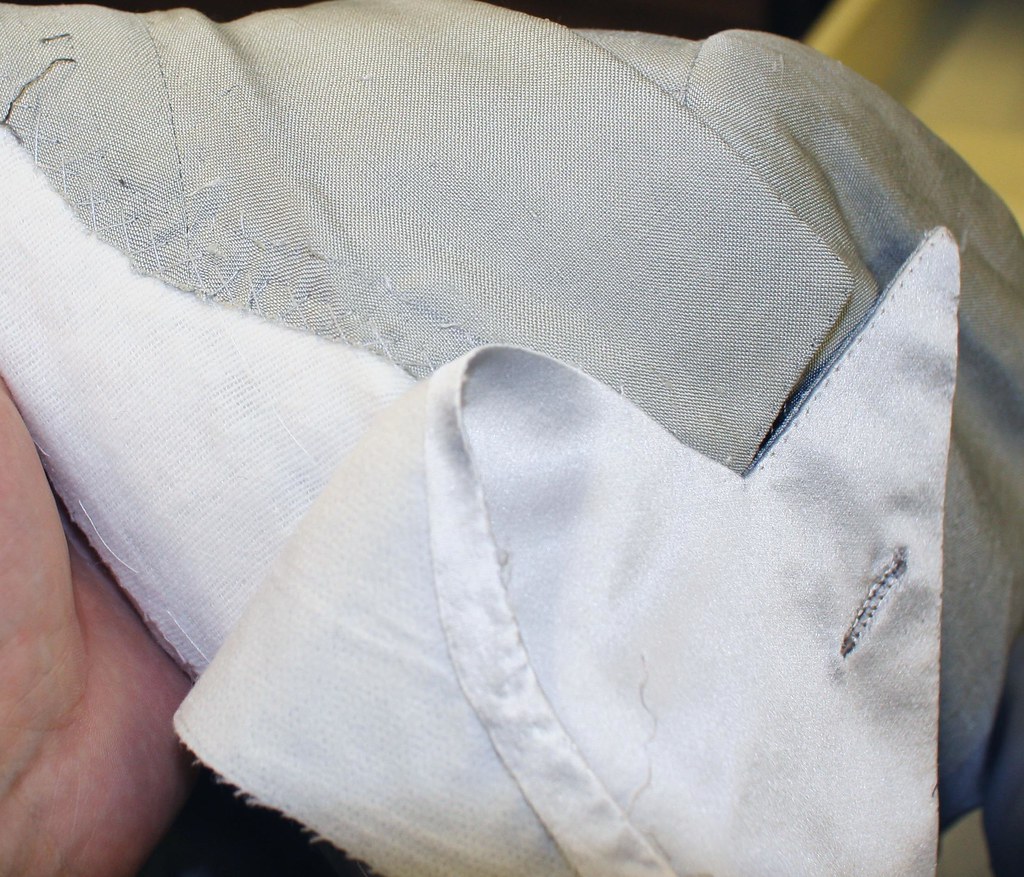
A curiosity here- the top collar is cross-stitched to the lapel by hand. What is a bit curious is that normally the top collar goes on AFTER the facing, but in this case it is clearly put on first. The facing must then be drawn on by hand. Which is curious in a factory setting. You may also notice that I have unpicked the lapel buttonhole to examine it more closely. This one needs some more research as to how they did it- I have seen this "upside-down" lapel buttonhole on some Zegna Couture, some Tom Ford, and some Neapolitan garments- the purl is much smaller and underneath the lapel making a very smooth, shiny buttonhole as though it had been done with a satin stitch and not a buttonhole stitch; the right gimp is crucial to this, I think. But back to the lapel sewing.

In a bespoke atelier where the shape of the lapel and position of the gorge may change during fittings, it is common to shape the lapel during the fitting, baste the seam allowances in place to check the result, and then fell them permanently to the canvas. The facing is then shaped with the iron, then basted on to the lapel, and slip-stitched in place. This is what we mean by hand-drawn; the gorge seam and the long lapel seam is sewn by hand. Here is an image from Sciamat's blog showing the process of sewing on the facing by hand.

drawn on

In heavier cloth this is fine but lighter cloth will never be quite as crisp as a machine-sewn edge. The other disadvantage is that only the jacket seam allowance is felled- the facing seam allowance is free; when machining the edge, both seam allowances can be felled to the canvas making for a crisper, flatter edge. Regardless, even Oxxford, who prides themselves on doing absolutely everything by hand, sew the facing on by machine (at least on the garment I looked at) In a factory setting where the shape of the lapel is pre-determined I don't see any reason at all to sew this seam by hand- in fact, I think it is one of the few spots where machines give better results. But apparently Brioni has a reason to do otherwise.

I suspect it has to do with the silk facing and the fact that it may be very fragile; I will have to check but I would be surprised to learn they do all their production this way. I certainly would have noticed the ridge formed when doing the collar first, as they have here, so I am fairly confident that this is exclusive to their dinner jackets. What is also a little odd is that this sequence makes it impossible to finish the facing and linings flat; normally I like to have the side seams joined, then work the facings and linings on to the jacket flat on a table (where I will have more control, and as Sciamat are doing in the photo above) before joining the shoulder seam. Then the under collar is affixed, then the sleeves set, then the top collar, then the lining finishing.

The sequence here is a little different- first, the lapel is pad-stitched, then the edges are trimmed and turned then felled in place, then the flannel is applied to the lapel and then the side and shoulder seams joined; the collar can then be applied, both the undercollar and the top collar. Perhaps they then set the sleeves and finish by working on the facing and lining by hand, which is more difficult to do with a closed coat (rather than flat); this would avoid possible damage to the very delicate silk during the production cycle, as there are many opportunities to snag on machines, tables, and people.

All this extra work to preserve the delicate silk costs LOTS of money so the synthetic facing is now looking like a much more economical option, and most lay people probably wouldn't be able to spot the difference on a finished garment.

So once again the Brioni is splendidly made and delightful to look at and wear for the connaisseur; it is perhaps a bit like a wine novice spending hundreds (thousands?) on a bottle of Chateau Petrus- will he really appreciate it or would he be better off buying something more affordable which he will find equally pleasant? That is a question that only the consumer can answer for himself when making a purchase. It's all a question of budget and taste, I guess. На вкус и на цвет товарищей нет.

StumbleUpon.com

Wednesday, September 23, 2009

Brioni vs Samuelsohn- a look inside

Continuing the look at these two dinner jackets, we start to look at the guts of the coats, the interior workings, starting with the hem felling.

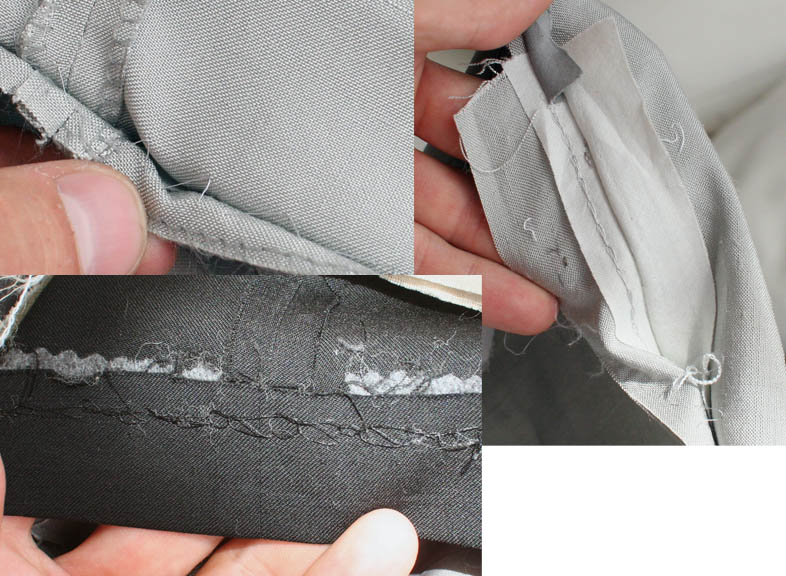
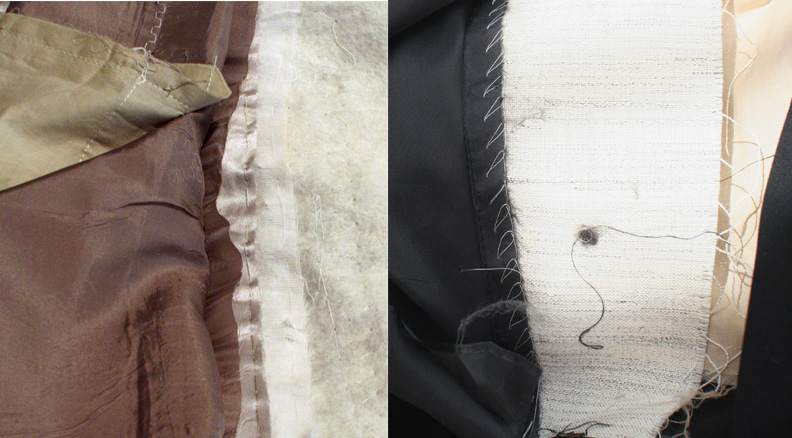
The hem has been blind stitched by hand (top left) using a very fine thread- thick wools are easy to do but a fine, tight silk is quite a challenge so I am impressed wit he skill of their hands. In a previous post we saw there was some sort of pick stitching running along the hem of the Brioni coat; now that it’s open we can see that there is a Silesia hem interfacing that has been held in place by a Columbia stitch (upper right).

The hem interfacing is a fusible non-woven (the light grey creeping over the edge of the hem) and the hem has been blindstitched by machine.

The importance of the hem interfacing is that the Silesia will never delaminate (never come unglued) from dry cleaning or steaming which, though rare now, is a risk with the fusible interfacing. The structural difference between stitching the hem by hand or by machine is so minuscule that, in the long run, I don’t think it matters to the quality. I will make a distinction between quality and craftsmanship, however.

Compared to a fused garment, whose hem is usually only tacked in place along the seams and will definitely sag when steamed or cleaned, or just with wearing in humid climate, there is a definite difference in quality between that and a felled hem like the two above. So between the fused garment and a Samuelsohn there is a huge, measurable difference in quality and the extra money is definitely worth the investment; between the Samuelsohn and the Brioni, however, there is a nuanced level of superior craftsmanship- what you are paying for in the Brioni is no longer necessarily a longer-lasting or more comfortable garment than the Samuelsohn, but a level of craftsmanship which the Samuelsohn does not have. If you area an oil sheikh for whom money is no object, the Brioni is the clear choice because of the skill and craftsmanship required to make it; if you are on a budget and are just looking for reliability (a Chevrolet, perhaps) then in your case it may not be worth the extra money to go up from Sammy to Brioni. Nuance.

Whew.

Hems


Inlays

Brioni
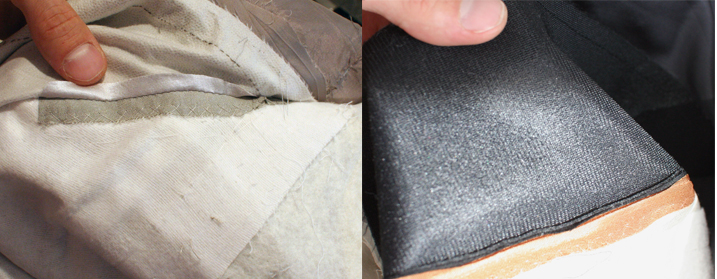
Notice that all the edges are overlocked. Silk ravels a lot so this is absolutely a necessity; good wool won’t ravel as much so it is not required. The inlays at center back and the side seams are about 5/8” wide; if you were to gain weight and have this altered, assuming a smallest possible seam of ¼”, you could then gain ¾” at each seam, or a total of 2 ½” circumference

Samuelsohn
Curiously, the inlays are 7/8” wide. So by the same math you could gain 1 ¼” at each seam, or a total of 3 ¾”.

Inlays

At this point I have a good look at the finishing of the lining in the Brioni and it is clear that the little pickstitch along the edge of the facing seam is not decorative- the lining has all been inserted by hand, though I would need a good macro lens to show it clearly. Which brings me to the construction of the facing and the lining.

Brioni

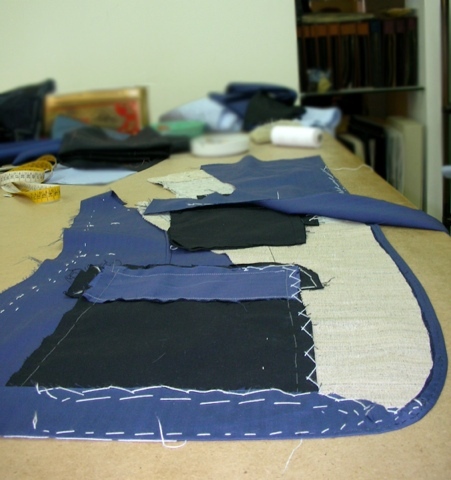
The silk has been fused with a soft non-woven interfacing to prevent some of the seams and stitching underneath from showing through. They have taken the step of covering the canvas of the lapel with flannel so that the canvas and the inner works don’t leave marks, but this is not enough to cover the edge seams, which are graded to avoid thickness. In the photo on the left you can see the lining peeled back, then the satin facing, and about one inch of the flannel extending past the silk, then the felt covering the chest piece. The silk has been tacked to the canvas using a long hand basting. The way that this has been constructed is a clue that the facing has been made in the traditional way, that is to say, it has been drawn on by hand, though this will be confirmed once the facing is open completely.

Samuelsohn
The facing has been felled to the canvas by blindstitch machine. Again, structurally equivalent to doing it by hand (it is no more secure by hand than by machine) but it is an indicator of the process of building the inside. The lining was joined to the facing by machine, then the pockets made on the lining, then the facings were attached to the jacket fronts. After turning the edges, the facing is basted in place, along the edges and then along the lining seam, which permits this machine felling from the inside. The same could have been done (though by hand) on the Brioni, but we are about to find out it was not.

Facing felling

On the left is the gorge seam, and you can see that the canvas has been covered by flannel. You can also see that the gorge seam allowance has been cross-stitched by hand, but it is curious that it is the collar seam allowance and not the facing. This very important detail will be covered in a later post.

Faciing underside

PAD STITCHING

BRIONI-
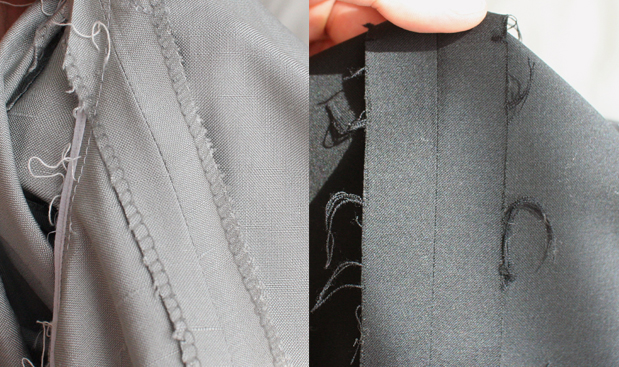
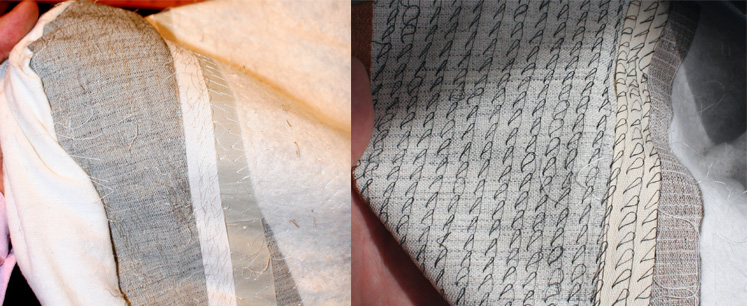
Though it is not very clear in the photo, peeling back the flannel we can see the pad stitching has been done by machine. It is irregular, telling me that they did not use the automated machine, perhaps because it is a peak lapel and they felt the need to vary the stitching through the peak. It’s what I would do.

Samuelsohn
The neat rows of stitching indicate that this was done on the automated pad stitching machine.

lapel padding

At this point I can tell for sure that the Brioni facing and collar have been drawn on by hand, whereas the Samuelsohn, like almost all other manufactured suits (including Oxxford) has been done by machine. This will require a whole post unto itself.

StumbleUpon.com

Thursday, September 17, 2009

Brioni vs. Samuelsohn, Battle of the dinner jackets

So before we go back to the pagoda shoulder, a side-by-side comparison of two dinner jackets, one by Brioni and one by Samuelsohn. This will be done in several parts as I am too lazy to get it all done in one shot. Samuelsohn is on the low price end of the full-canvas makes and Brioni on the higher end (in this case, the Brioni is easily four times the price of the Samuelsohn, if not a little more). So what makes the difference?

Cosmetics- both are one-button, peak lapel DJs. The Sammmy is 100% wool with a center vent, the Brioni is 100% Silk with no vent.

Buttonholes
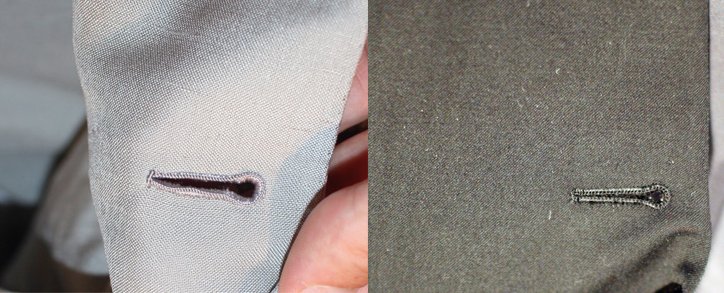
Brioni- made by hand
Samuelsohn- made by machine

buttonholes

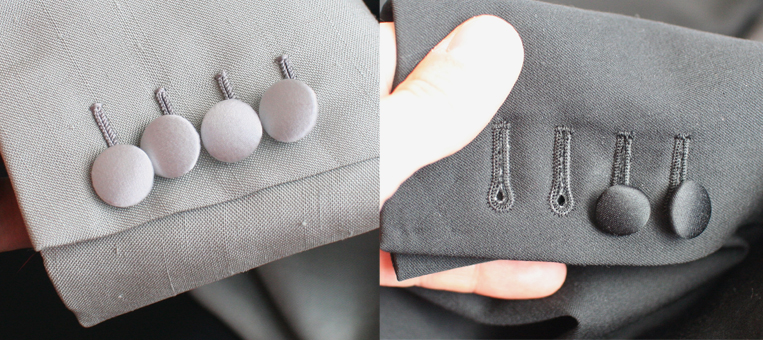
Sleeve finishing
Brioni- hand-made immitation buttonholes
Samuelsohn- machine-made functioning buttonholes, hand-finished sleeve lining

Sleeve finishing

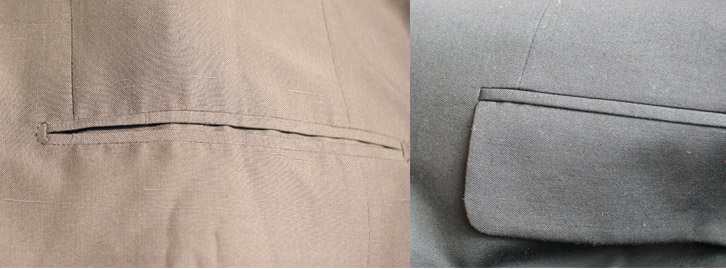
Pockets
Brioni- hand-made, flat construction jetted pocket (nice, soft, flat, discreet) with hand-stitched mezza-luna tack
Samuelsohn- machine-made (ribbed) flap pocket

Pockets

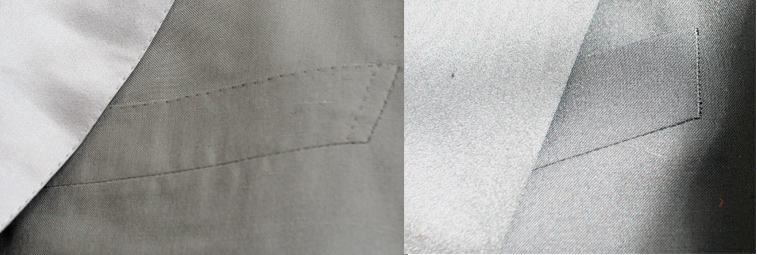
Breast Welt

I apologize if it's not clear.
Brioni- hand-made and finished pocket welt, pick stitching also done by hand
Samuelsohn- machine-made welt with tiny zig-zag stitching to fell the edge of the pocket, no pick stitching.

breast welt
Let's pause for a moment.

There is some confusion about pick stitching and what it is or is for. Pick stitching is the tiny little stitches on the edge of some garments- it is placed there to hold the edge crisp and flat, to prevent edges from rolling, but is not structural. As such, a hand stitch is the same structurally as a machine stitch- they both do the same job. Machine pick stitching is not meant to bamboozle anyone- it performs the same function as hand stitching.

HOWEVER

Hand stitching is much smaller and looser and thus more discreet than machine stitching (I'll show both later) and once you're seen the two side-by-side it's easy to tell them apart. Some makers (mostly southern Italians) do their hand stitching with a slightly thicker thread and is just as ornamental as it is functional, but it is still easy to tell them apart by the slight irregularity of the stitches and the tiny prick of the hand stitch.

Hand stitching machines have pretty intense feeders which tend to damage delicate satin, which is why it is not so common to find it on dinner jackets and why there is none on this Samuelsohn garment. It is also much more evident on Satin than on regular cloth and some people find it ostentatious so is often omitted. It was a necessity on the Brioni, for reasons we will get to later.


Boutonniere

Brioni- there is a hand-made buttonhole done with the upside-down buttonhole stitch I was studying in a previous post (and now realize I may have posted the wrong photo) plus a boutonniere loop underneath.
Samuelsohn- no lapel buttonhole

Boutonniere

Facing

Brioni- The facing on the Brioni is a luxurious pure silk which is not common to see any more because it is very delicate; damages are common and replacing a facing on a finished jacket is one of the most infuriating jobs. If you are wearing real silk lapels, do not hug anyone wearing jewelry, and keep your dancing partner at a distance for fear of snags. But it is VERY nice.....
Samuelsohn- This has the more common synthetic facing. Note that this type of satin is made specifically (and only) for tuxedo facings and is just as expensive as real silk in most cases. It is popular because it is more resistant to damage, not only during construction but during wear.
In this part we look at some of the details that we can see inside the jacket but without opening the lining up. Clues for the thrifters among us.


Hem finishing

Brioni- The hem has been closed by hand with a tight little stitch. There is also what appears to be a pick stitch running close to the hem- most likely holding wiggan or some sort of hem interfacing in place. It looks like this was done with the Columbia machine (Juki makes one too) which is a type of imitation hand stitch. More on this in a minute.

Samuelsohn- This hem was closed by a felling machine- the two parallel threads are what distinguishes the machine stitch from a hand stitch which may look similar. This type of stitch is usually a good indicator that the coat was not bagged and that the hem itself was felled rather than just tacked like in lesser garments.

Lining hem

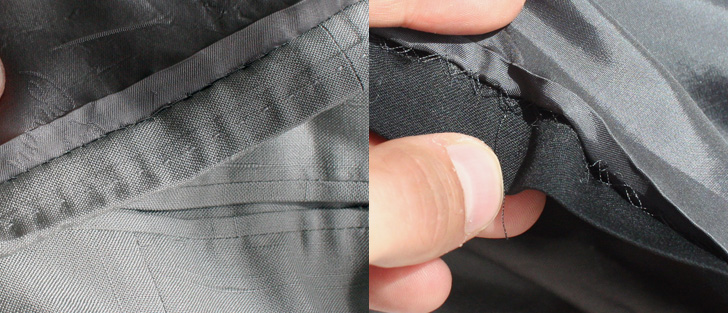
Facing and lining seams

Brioni- there is a little pick stitch which was clearly done by hand along this seam. Some manufacturers put a Columbia stitch as decoration along this seam, but on garments such as this, it is possible that the stitch is not primarily decorative but functional- it may be used to fell the lining to the facing by hand. This can also be done with a more discreet stitch, but if the finisher is talented, it can be functional as well as decorative. The lining must be opened up to know for sure.

Samuelsohn-
The lining has been closed by machine and there is no decorative stitching along this edge

Facing lining seam

Neck Finishing

Brioni- several interesting things. The pick stitching continues around the neck, a further suggestion the lining has been felled by hand. Notice that the lining is lapped over the collar. Also notice the seam in the collar stand- this is a two piece collar, as in my previous post about collar drafting. Silk is very difficult to shape with the iron so they were wise to make this a two piece and avoid possible fit trouble. The shoulder seam of the lining has been felled by hand, which means the lining is held in place along the shoulder pad and won’t shift around.

Samuelsohn- The collar is lapped over the lining, and felled with a machine-made pick stitch; there is also a row of pick stitching just inside the roll line to hold things in place. The shoulder seam has been closed by machine which means it is loose and not tacked to the shoulder pad.

Neck lining

StumbleUpon.com